A food market brings ingredients into view before they become a meal. The arrangement of fruit, greens and bread gives a visitor something to look at, but the more useful questions concern the food itself: where it comes from, how it is handled and what cooking it needs. A market walk in Paris or Nice can begin with those small questions. It need not become a contest to identify a famous stall or to collect names.
A street setting and a direct sale
A street market describes a setting; a farmers' market describes a relationship between producer and customer. Wikipedia's article on farmers' markets defines them as marketplaces intended for farmers to sell food directly to consumers. They may take place indoors or outdoors, using tables, booths or stands. A public market is a broader category and can include traders who did not grow or make everything they sell.
The distinction gives a visitor better questions to ask. Knowing whether the seller grows the vegetables is different from knowing where a vegetable was grown. Neither answer needs to become a judgment about every other way food is sold. The same article connects growth in farmers' markets with consumer interest in freshness, shorter transit and variety. Markets sit within a changing food system, rather than outside it. The farming and food-policy notebook follows those wider relationships.
From a Paris market to a French meal
French food traditions include many regional dishes that have spread in variations through the country. Cheese has a place in the wider cuisine, but a market basket still needs a particular purpose. Choose ingredients with a meal in mind: something to cook first, something to keep for later and a clear place for the most delicate produce. A basket filled only because everything looked appealing can become difficult to use well.
UNESCO's listing of the gastronomic meal of the French describes a social practice for celebrating important moments, with attention to selecting dishes, choosing products and setting the table. The meal is about togetherness as well as taste. That cultural account puts the market purchase in a longer sequence, from deciding what to cook to sharing the finished food. It also leaves room for ordinary kitchen work: washing, sorting, cutting and preparing before the guests sit down.
The London notebook supplies another city setting for markets and puddings. Reading the cities together can sharpen attention to the differences between a market, the food displayed there and the meal that follows. A place name alone tells less than a close description of how an ingredient is used.
Nice, a chickpea pancake and delicate flowers
In Nice, socca offers a prepared-food counterpoint to the raw ingredients of a market. It is a chickpea-flour pancake seasoned with black pepper. The home recipe below brings that idea into a hot pan, making a thin savory pancake with browned edges. It can be torn into pieces at the table instead of cut into tidy identical wedges.
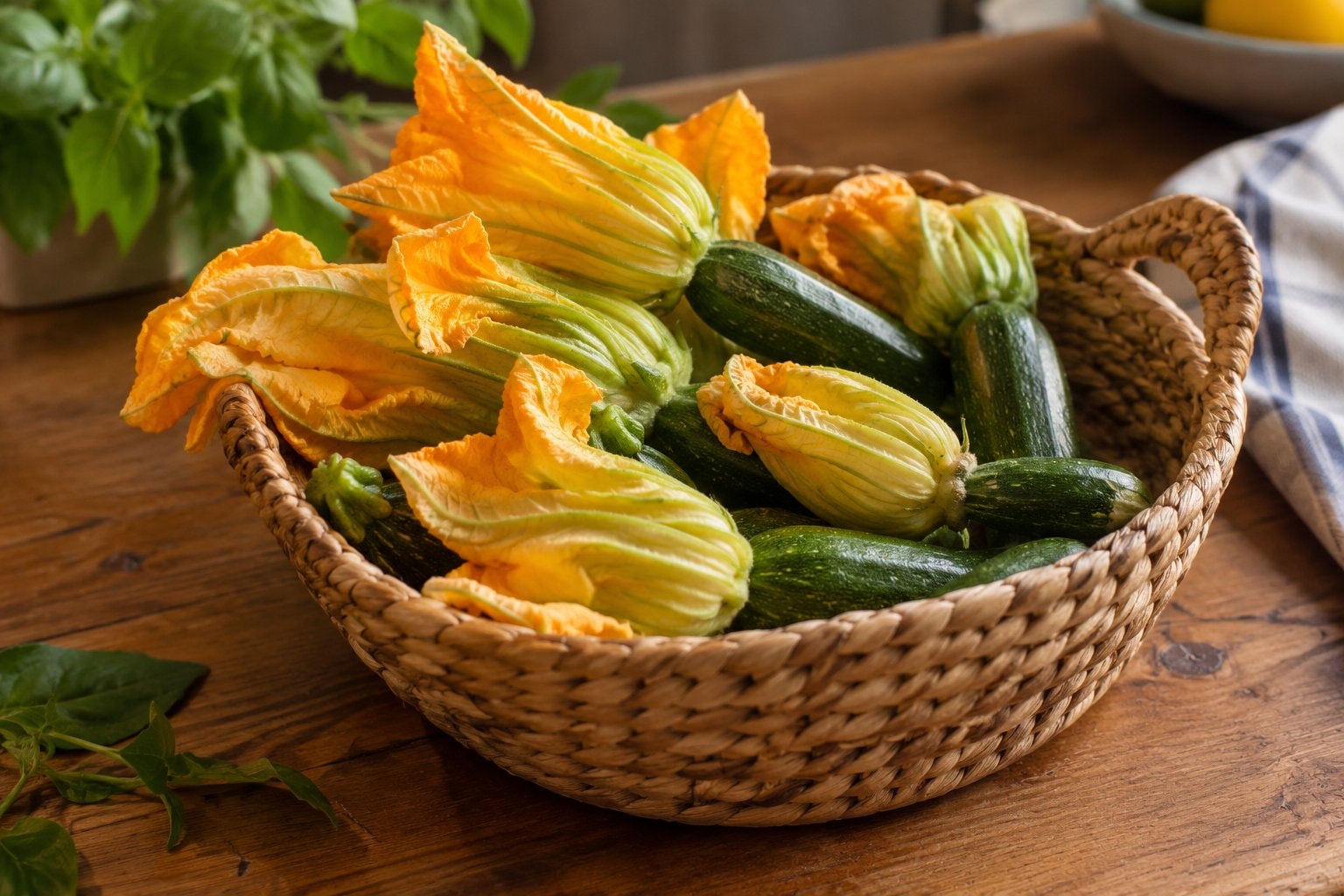
Squash blossoms show another side of the produce basket. They are the edible flowers of squash plants, including zucchini, and they are highly perishable. They may be stuffed, battered and fried, or used in soup. The flower's gentle flavor is compared with young zucchini. Their fragility suggests a practical order for cooking: use the delicate flowers promptly and leave the sturdier ingredients for another meal.
The kitchen-garden essay looks at tomatoes, squash and the growing side of that basket. At home, sort produce before putting it away, keeping easily bruised items from being crushed under heavier ones. A little attention when unpacking makes the later cooking less hurried.
Reading the seasons
Wikipedia's definition of seasonal food concerns the period when harvest or flavor is at its peak. That is a useful question rather than a rule that every ingredient must arrive at the same moment. Ask which fruit is ready to eat, which vegetables were recently harvested and what preparation the seller suggests. A season is easier to understand through the ingredients themselves than through a slogan.
Chestnuts give autumn another texture. Their nuts fall in that season, and the edible seed belongs to a different kitchen task from the soft flower of a squash plant. Cooked chestnuts can be kept covered and refrigerated or frozen. Prepared whole nuts can be chopped into a filling or used as a soft element beside roasted vegetables. The practical point is to plan their use, just as with a more delicate purchase.
Socca in a hot skillet
Wikipedia's account of regional pancakes identifies socca as a chickpea-flour pancake and a street food in Nice. This version is made for a home oven with a heatproof skillet. Serve it hot, while the edge is crisp and the center still tender.
Yield: 2 pancakes, serving 4. Active time: 20 minutes. Total time: about 1 hour 15 minutes, including resting.
Ingredients
- 150 g (1¼ cups) chickpea flour
- 300 ml (1¼ cups) water
- 45 ml (3 tablespoons) olive oil, divided
- 3 g (½ teaspoon) fine salt
- 1 g (½ teaspoon) freshly ground black pepper
Method
- Whisk the flour, water, 15 ml (1 tablespoon) oil and salt until smooth. Let the batter stand for 30 minutes, then whisk again. It should pour freely.
- Heat the oven to 250°C (475°F). Put a 26 cm (10 inch) cast-iron or other suitable ovenproof skillet inside for 10 minutes. Use a pan whose handle and surface can tolerate this heat and broiling.
- Carefully remove the hot skillet. Add 15 ml (1 tablespoon) oil and tilt to coat. Pour in half the batter and return to the oven. Bake for 8–10 minutes, until the top is set and the edges begin to brown.
- If more color is needed, broil briefly, watching continuously. Remove with oven gloves, scatter with half the pepper and loosen the pancake with a spatula. Transfer to a board or plate.
- Reheat the pan briefly, then repeat with the remaining oil, batter and pepper. Tear or cut the pancakes into pieces and serve immediately.
Kitchen notes
Keep the batter layer thin rather than pouring the whole batch into a small pan. Whisk between batches because the flour can settle. Hot skillet handles stay hot after leaving the oven; keep an oven glove nearby and place the pan on a heatproof surface.