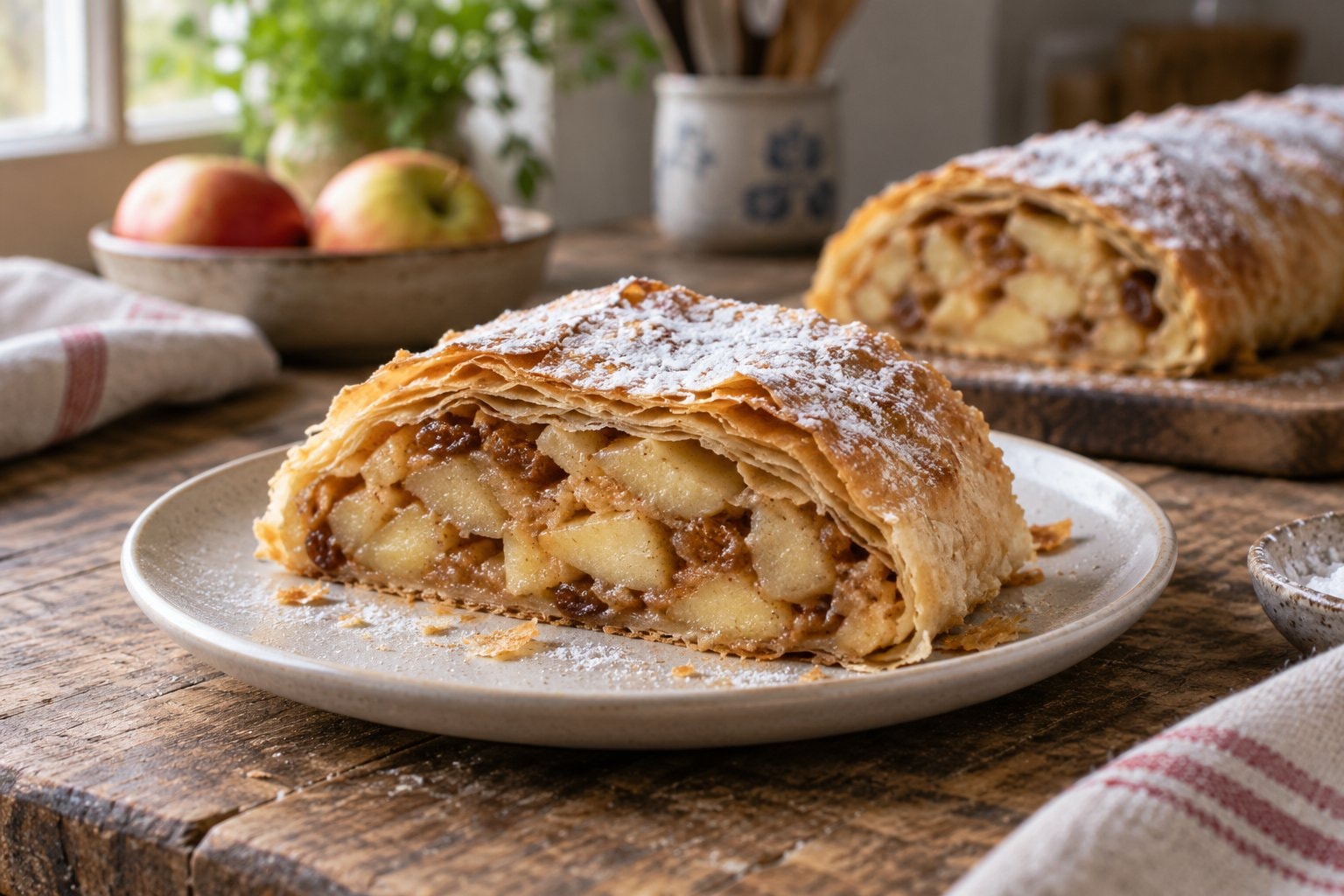
Vienna's food is an invitation to examine surfaces and layers. A strudel has a fragile pastry skin wrapped around fruit. Sachertorte brings chocolate sponge, apricot jam and glaze into a carefully assembled cake. Wiener schnitzel gives a thin piece of veal a crisp breaded coating. These dishes differ in flavor and purpose, yet each asks a cook to pay attention to the meeting point between an outside and an inside.
The coffee-house table and its wider setting
Wikipedia's Austrian-cuisine account describes coffee drinking as a social activity, with coffee and cake shared at home as well as in cafés. It places Viennese cooking within a country of distinct regional traditions and within the influences of neighboring Central European cuisines. The coffee-house table is therefore a useful starting point, rather than a complete definition of Austrian food.
A slice of cake gives a conversation a different rhythm from a full meal. It can be considered slowly, from the glaze to the crumb. That is part of the pleasure of studying a pastry tradition: the object is small enough to examine closely, yet it carries several techniques. The cake-maker's vocabulary includes mixing, aerating, filling, coating and cutting. Strudel adds another kind of skill, in which stretching and rolling take precedence over a sponge's rise.
The source distinguishes specialist cake-making from the simpler structure of some desserts. It describes strudel as thin pastry enclosing apples, often with cinnamon and raisins. The contrast is useful at home. A cake may need careful assembly in stages, while a fruit pastry asks for dough that stretches, filling that is prepared before the wrapper is ready, and enough space to roll it without haste.
Chocolate sponge, jam and a breaded cutlet
Wikipedia's Sachertorte article identifies the Austrian confectioner Franz Sacher as its creator and describes the cake's combination of chocolate sponge, apricot jam and chocolate glaze. That description is sufficient to understand the structure without choosing among commercial versions. The jam is a distinct layer of fruit between chocolate elements; the glaze finishes the surface. Each component has a job, rather than merely adding more sweetness.
There is a similar clarity of parts in Wikipedia's description of Wiener schnitzel: a thin veal cutlet is breaded and pan-fried. The adjective Viennese refers to a specific dish, not every breaded piece of meat. In thinking about it, the coating and the cutlet deserve separate attention. A thin center and a crisp exterior create the contrast that gives the dish its recognizable form.
The pastry table offers its own range of contrasts. The apple essay follows fruit into brown Betty and cider country, while the fruit-pie essay considers enclosed fillings and softer spoon desserts. Strudel belongs beside them as an example of how a wrapper changes a familiar fruit. It is worth approaching the dough as a material to learn, with a clean work surface and the filling already at hand.
Learning a stretched dough
Strudel dough is unleavened and elastic. Kneading develops it; resting gives the cook a more manageable piece to stretch. Work gradually from the center toward the edges, using the backs of the hands so fingertips do not make holes. A cloth under the dough makes the final roll easier to lift. The aim is a thin sheet, but a small tear need not end the attempt: the rolling creates overlapping pastry, and an isolated patch can sit inside.
The recipe uses toasted breadcrumbs to provide a dry layer beneath the apples. Slice the fruit thinly so that it cooks within the pastry's baking time, and avoid leaving the prepared filling sitting in its sugar for too long. The recipe's shape is an oblong roll. It does not need an elaborate decoration; the interest appears in the cut face, where thin pastry surrounds the apple filling.
Apple strudel with stretched dough
Wikipedia's apple-strudel reference describes the traditional Viennese pastry and the kneading, resting and stretching of its dough. This home version uses tart apples, cinnamon and a modest amount of raisins. Set out a clean cloth and a broad work area before beginning.
Ingredients
- 250 g (2 cups) all-purpose flour, plus a little for dusting
- 130 ml (½ cup plus 2 teaspoons) lukewarm water
- 30 ml (2 tablespoons) neutral oil, plus a little for coating
- 3 g (½ teaspoon) fine salt
- 80 g (5½ tablespoons) unsalted butter, divided
- 50 g (1 cup loosely packed) fine fresh breadcrumbs
- 900 g (2 lb) tart apples, peeled, cored and thinly sliced
- 100 g (½ cup) granulated sugar
- 4 g (2 teaspoons) ground cinnamon
- 60 g (⅓ cup) raisins
- 15 ml (1 tablespoon) lemon juice
- 10 g (1 tablespoon) powdered sugar, for finishing
Method
- Mix the flour, water, oil and salt into a soft dough. Knead on a clean surface for 8 minutes, until smooth and elastic. Coat lightly with oil, cover and rest for 40 minutes.
- Melt 50 g (3½ tablespoons) of the butter in a skillet. Add the breadcrumbs and stir over medium heat until pale gold. Transfer to a plate and cool. Heat the oven to 190 °C (375 °F) and line a baking sheet.
- Dust a large clean cloth with flour. Roll the dough into a broad rectangle, then ease the backs of the hands underneath and stretch gently toward the edges. Aim for about 60 × 45 cm (24 × 18 inches). Trim any thick rim.
- Melt the remaining butter. Brush some over the dough. Scatter the crumbs over the lower part, leaving a border. Toss the apples with sugar, cinnamon, raisins and lemon, then arrange over the crumbs.
- Fold the side borders inward. Lift the cloth to roll the dough around the filling, making an oblong parcel. Transfer seam down to the sheet. Brush with the remaining melted butter.
- Bake for 40–45 minutes, until crisp and golden and the apples are tender. Rest for 15 minutes before slicing. Dust lightly with powdered sugar just before serving.