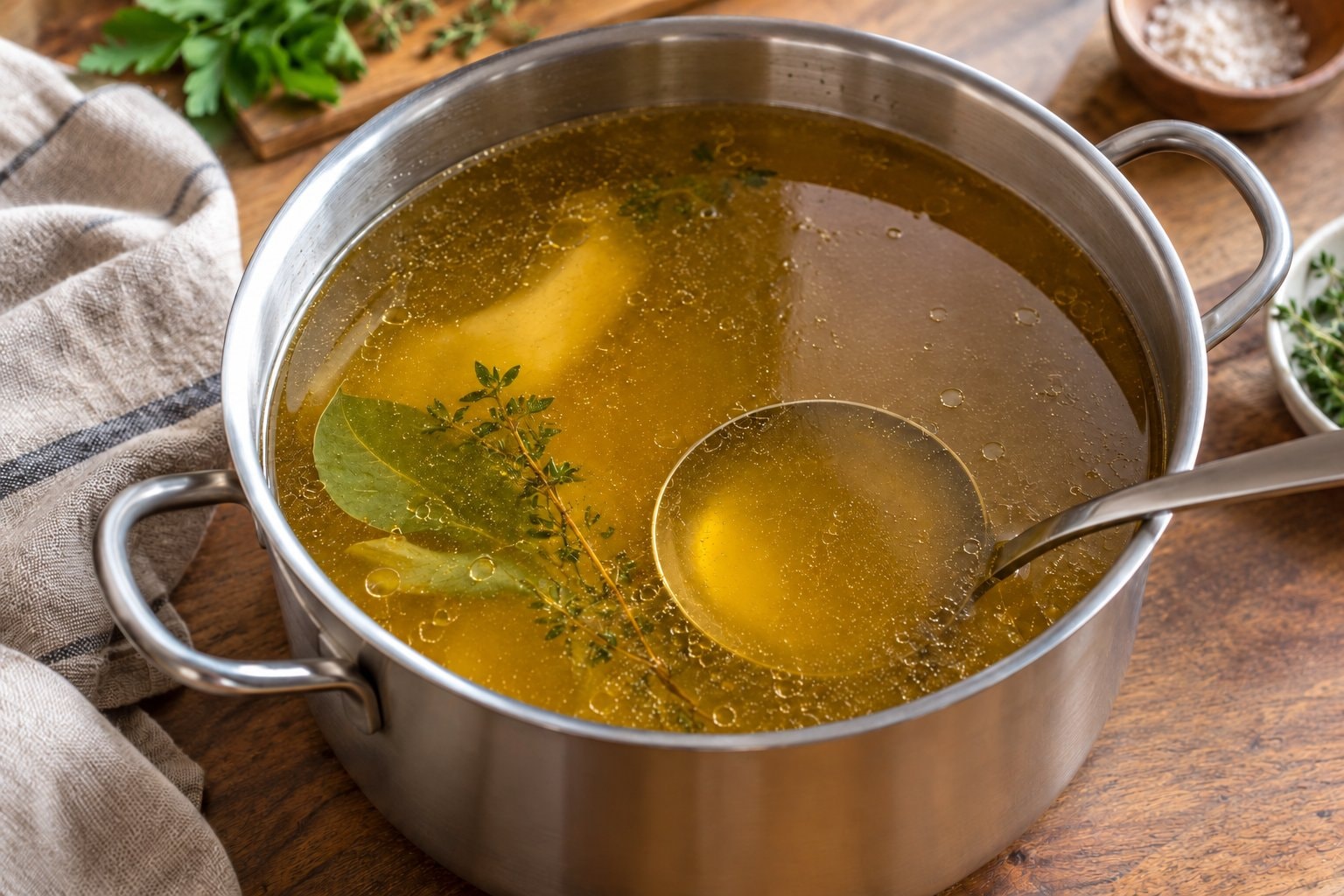
A chilled pot of stock can tremble when a spoon touches it. Warm the same liquid and it flows again. That small change connects everyday cooking to the structure of an animal: connective tissue, collagen and the gelatin produced during cooking. It also invites a separate question about what happens after food is eaten. The kitchen observation is easy to make. Research about absorption and joints asks different questions and needs its own evidence.
Finding a use for bones and tougher cuts
Buying meat involves more than choosing a tender piece for quick cooking. A cook can think about the purpose of each cut, the bones left after a meal and the dishes that make use of both. Game means wild animals hunted for food or other purposes; the animals regarded as game vary with place. It belongs in this discussion as food culture, with local rules and practices, rather than as a reason to hunt or an instruction for handling a wild animal.
A whole-animal approach can begin with a cooking plan: tender pieces for a quick method, tougher pieces for a moist dish, and suitable bones for stock. The stock reference includes both bones and meat cuts with substantial connective tissue. This is a way of organizing kitchen uses, leaving questions about species and local rules separate from the recipe.
Connective tissue helps explain why some cuts suit a moist, patient method. In a 2018 review in Meat Science, Purslow describes collagen denaturation as dependent on the rate of heating, with a range of 55–60 °C under slow heating conditions. That is a research observation about a changing protein, not a cooking temperature or a food-safety instruction. The review also challenges the idea that connective tissue contributes an unchanging background toughness. A single temperature cannot tell the whole story of a cooked cut.
Stock puts the change to practical use. Wikipedia's account of stock-making describes simmering bones with water and aromatics, and explains that connective-tissue collagen becomes gelatin, which thickens the liquid. Cooked meat still attached to bones can contribute flavor. Onion, carrot and celery build the aromatic background; their role is quite different from the bones' contribution to texture.
A pale stock starts with unroasted ingredients. Roasting bones first creates a darker version with a different flavor. Wikipedia's Maillard-reaction account describes browning through reactions between amino acids and reducing sugars; it gives the browned surfaces a chemical explanation. The essay on browning and caramel follows the Maillard reaction in other foods. Here, the plain stock keeps the focus on a gentle simmer and a clean chicken flavor. It can become the liquid for soup, a sauce or a dish of vegetables without prescribing the final seasoning.
Plain chicken stock
Wikipedia's stock reference describes a cooking liquid made by simmering bones and aromatics. This chicken version keeps that structure simple. Leave it unsalted so that its final seasoning can suit the dish in which it is used. The finished texture depends on the bones and on evaporation.
Ingredients
- 1.5 kg (3¼ lb) chicken bones with a little meat attached
- 3 liters (about 3 quarts) cold water, plus more if needed to cover
- 150 g (1 medium) onion, quartered
- 100 g (1 large) carrot, cut into broad pieces
- 100 g (2 medium stalks) celery, cut into broad pieces
- 5 g (a small handful) parsley stems
- 1 bay leaf
- 2 g (½ teaspoon) whole black peppercorns
Method
- Put the bones in a large pot. Add the water, keeping enough space above it to prevent spills. Bring to a full simmer, then lower the heat until the surface moves gently.
- Skim away the foam that rises. Add the onion, carrot, celery, parsley, bay leaf and peppercorns. Keep the pot partly covered and simmer for about 3 hours. Add a little water if the bones become exposed.
- Set a fine sieve over a clean heatproof bowl. Ladle the liquid through it, then pour carefully. Avoid pressing the solids hard; the aim is a clear, pleasantly flavored stock.
- Divide immediately among shallow heatproof containers. Stand them in an ice-water bath and stir with a clean spoon to cool quickly. Refrigerate promptly, with space around the containers for cold air to circulate. Cover once cold.
- Lift off the fat that firms on top if desired. Bring the stock to a full simmer when using it in another dish. Freeze any that will not be used promptly.
From a kitchen jelly to body structure
Wikipedia's gelatin article describes it as an ingredient derived from collagen that forms a gel on cooling and melts with reheating. Its account of aspic describes a savory stock jelly enclosing other foods, while the panna cotta article describes sweetened cream set with gelatin. These are changes in food texture.
Wikipedia's collagen reference identifies collagen as the most abundant protein in mammals and a major structural component of connective tissues, with type I occurring in skin, tendons and bone; type II characteristic of cartilage, and type III in reticular fibers, often beside type I. Cartilage is itself connective tissue, with collagen in its matrix. Naming the same protein in a body and a saucepan does not establish an effect from eating it.
MedlinePlus explains protein digestion in terms of amino acids, the smaller building blocks released when food protein is broken down. Its dietary-protein overview includes animal and plant sources. Peptides are short amino-acid chains. Glycine and hydroxyproline are characteristic parts of collagen's structure. These definitions help a reader follow a laboratory result without turning that result into dietary instructions.
What the studies actually examined
In a 2015 food-science review, Liu and colleagues discussed collagen and gelatin structures, sources and applications. They cautioned that structure can vary with source and season. A broad review of possible applications is a different kind of evidence from a trial examining a defined outcome.
Wang and colleagues' 2015 study examined oral gelatin in rats and reported substantial absorption in the form of collagen peptides. It was a rat study, not evidence of human joint outcomes. Asai and colleagues' 2019 study measured collagen in everyday Japanese dishes and detected collagen peptides in human blood after cooked fish. Detection in blood does not by itself answer a clinical question.
Alcock and colleagues reported in 2019 that bone broth had low and variable concentrations of relevant amino acids compared with the collagen preparations used in research. Their comparison gives no basis for treating a home stock as equivalent to a study preparation.
A 2025 systematic review in Orthopedic Reviews examined type I collagen hydrolysate studies concerning bones, muscles and joints. It reported beneficial findings in joint studies, inconclusive findings for bone and inconsistent findings for muscle. Differences between studies limited generalization. The review also disclosed that an author worked for a collagen producer.
A 2018 review in the British Journal of Sports Medicine included collagen hydrolysate among preparations with short-term pain findings in osteoarthritis studies. The overall evidence quality was very low, and the review found no clinically important effects at medium or long follow-up. That qualification belongs beside the reported finding.
Food is not medicine, and the interpretation of this research remains contested. Anyone with a joint or health question should speak with a qualified health professional. For the cooking questions, continue with custards and their different ways of setting, eggs in batters or the wider questions of farming.
this is general information, not medical advice.