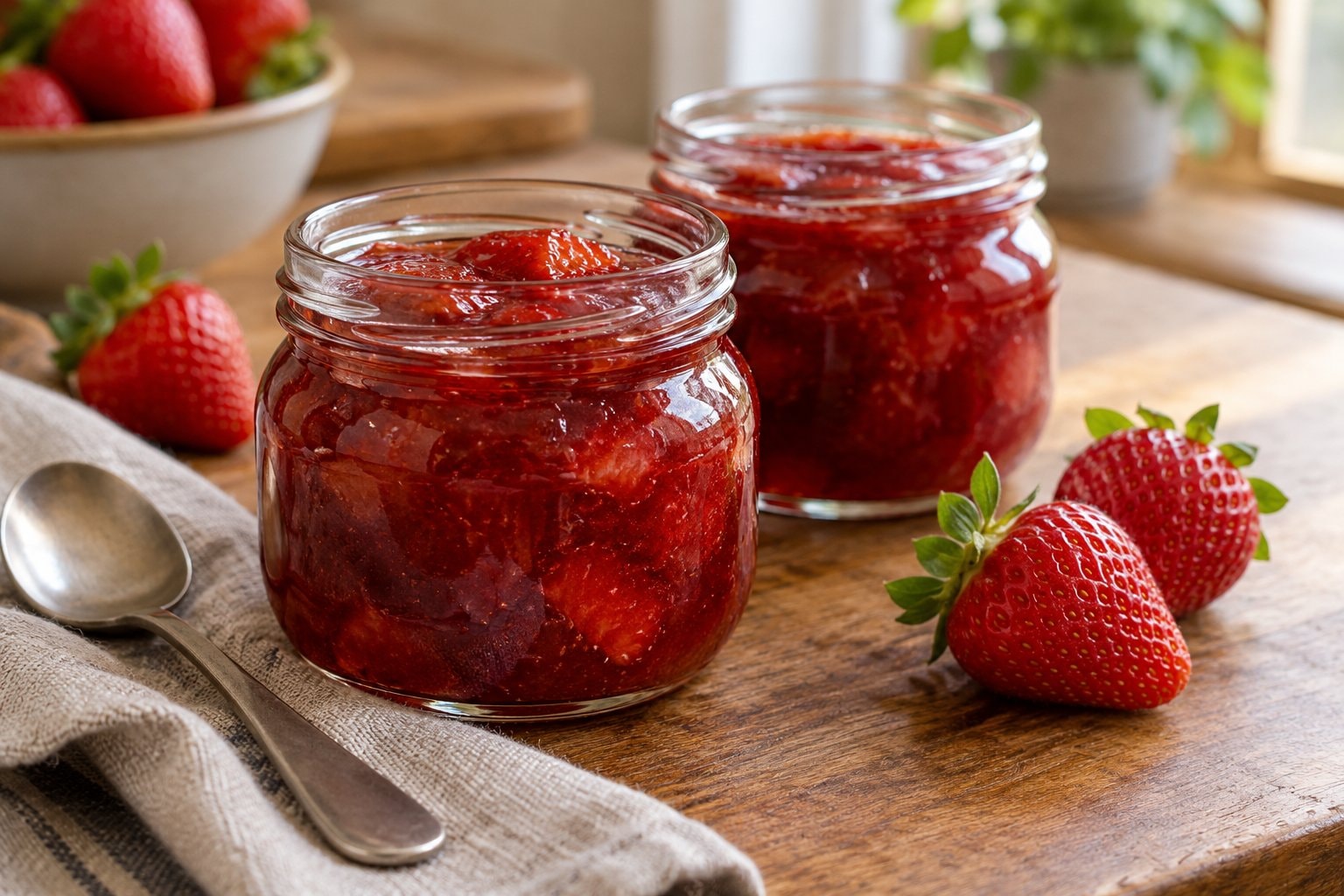
A preserve changes fruit into something that can be spread, spooned or slipped between layers of cake. The fruit still matters, but so does its form: clear juice, crushed flesh, soft pieces or citrus peel. Wikipedia's account of fruit preserves describes a broad family whose members differ by preparation, fruit and place in a meal. Looking closely at those differences is more useful than treating every jar as the same kind of jam.
What remains of the fruit
Jam begins with fruit cut into pieces or crushed. Jelly has an additional filtering step that removes the pulp, leaving a clear or translucent spread. A conserve can mean fruit stewed in sugar, kept in more recognizable pieces; the word is also used for mixtures that may include dried fruit or nuts. The terminology varies, so texture is often the clearest guide. A spoonful with seeds and soft pieces has a different role from a clear jelly that trembles on the plate.
Wikipedia's description of marmalade identifies citrus juice and peel boiled with sugar and water. Bitter orange is a familiar version, but other citrus fruits can be used. The peel makes marmalade distinctive: it supplies something to bite into as well as flavor. Cut peel finely for a more even spread, or leave wider pieces when the texture of the peel is the point.
The apple notebook considers fruit in orchards and desserts, while the bread notebook supplies another setting for a preserve. On a slice of bread, the spread needs to sit comfortably on the crumb. In a cake, it needs to stay where it is placed. Thinking about the intended use helps a cook decide whether a softly set jam will do or a firmer filling is needed.
The set is a structure
Wikipedia's article on pectin describes its familiar kitchen use in giving jams and marmalades a jelly-like consistency. Pectin comes from plant cell walls. In conventional jam-making, sugar, acid and pectin work together to form a gel; different fruits provide different amounts of pectin. Apples, quince, gooseberries and citrus contain more than soft fruits such as strawberries. The fruit therefore brings part of the structure as well as the flavor.
The strawberry recipe below aims for a soft spoonable set. It uses no added pectin and makes a modest amount, so the result can remain a refrigerator spread. A cooled sample is more informative than the boiling pan: the hot mixture always looks looser. Drop a little onto a cold plate, let it cool and then judge whether it moves like syrup or holds together as a soft spread. Do not keep boiling merely to chase the firmness of an unfamiliar commercial jar.
Fruit for the spoon and the tea table
Strawberries are appreciated for their aroma, red color and juicy texture, and they are used in jam as well as eaten fresh. Figs can be eaten fresh or dried and made into jam. Gooseberries also belong to the dessert kitchen; early-picked fruit is generally sour and lends itself to cooking. These fruits do not have to become preserves to be useful. Cooked gooseberries have a place in the English fruit fool, where puréed fruit is folded into custard or, in modern versions, whipped cream.
Jam has familiar companions in the English tea setting. Sweetened scones are part of cream tea, with clotted cream supplying a thick dairy contrast. Clotted cream is associated particularly with Devon and Cornwall. The Victoria sponge offers a different arrangement: a cake sandwich whose filling can include jam and cream. A thin, even layer of jam makes sense there, letting the cake remain easy to cut. The London notebook follows the city's puddings and baked goods.
A jar is not a storage method
Home canning involves packing food into jars and heating them as part of preservation. That is a separate task from simply cooking fruit in a saucepan. A lid that closes does not turn a fresh spread into a shelf-stable preserve. The recipe here is refrigerator jam: keep it cold, use a clean utensil and make an amount that can be used promptly. Shelf-stable preparation calls for a tested method designed for that purpose.
Small-batch strawberry refrigerator jam
This softly set jam is for the refrigerator. For shelf-stable jars, follow the tested processing directions of the National Center for Home Food Preservation. The method below cooks a fresh spread; it gives no jar-processing directions.
Yield: about 400 g (1¼ cups). Active time: 25 minutes. Total time: about 50 minutes, including cooling before refrigeration.
Ingredients
- 500 g (about 3½ cups) strawberries, weighed after hulling
- 200 g (1 cup) granulated sugar
- 30 ml (2 tablespoons) lemon juice
Method
- Wash the strawberries, remove the hulls and cut large fruit into pieces. Put a small plate in the freezer for checking the set. Have clean food-storage containers with lids ready.
- Put the fruit in a wide, heavy saucepan and crush it lightly with a potato masher. Stir in the sugar and lemon juice. Warm over low heat, stirring until the sugar has dissolved and the fruit has released plenty of juice.
- Bring to a lively simmer and cook for about 15–20 minutes, stirring frequently, especially along the bottom. Reduce the heat if the mixture spits aggressively. Skim off foam with a spoon if it collects on the surface.
- Put a small spoonful on the cold plate and let it cool. Push it gently with a fingertip: for this recipe, a soft mound with only a little runny juice is enough. If it remains very liquid, simmer briefly and check another cooled sample.
- Take the pan off the heat. Let the bubbling subside, then spoon the jam into the clean containers. Cool briefly, cover and refrigerate promptly. Use within 4 days, or freeze a portion in a suitable container with room for expansion.
Kitchen notes
Keep this jam in the refrigerator, never in the pantry. Use sound fruit and discard any batch that develops mold. The cooled spread may be softer than a pectin-added jam; that is welcome on toast or spooned into plain yogurt. Do not turn the containers upside down or treat a closed lid as evidence of shelf stability.