A holiday cookie plate can offer a small lesson in baking. A thin spice biscuit breaks sharply, a butter-rich biscuit crumbles, and a soft chocolate cookie yields around its pieces of chocolate. Shape, texture and aroma make a more interesting collection than decoration alone. The broad cookie family includes doughs that can be rolled, scooped, pressed into molds or baked as a slab, and each asks for a different sort of attention.
Different countries, different shapes
Wikipedia's account of Christmas cookies describes Norwegian krumkaker as thin biscuits shaped into cones, Swedish pepparkakor as crisp ginger biscuits, and Dutch kerstkransjes as rings often decorated with almond pieces. France's Alsatian tradition includes bredele. The details matter because they show that a festive biscuit can take many forms. A rolled dough makes sharp edges, a special iron supplies a pattern, and a soft dough can be portioned with a spoon.
German Lebkuchen brings honey, spice and nuts into the Christmas baking tradition. Gingerbread is a wider category: the name covers baked goods ranging from a moist loaf to a crisp ginger snap, typically flavored with ginger and other warm spices. A dough scented with spice therefore does not always promise the same texture. The German Christmas-market notebook follows those flavors alongside the foods of winter stalls.
Shortbread keeps the ingredient story quieter, centering butter, sugar and flour without a raising agent. Its crumbly character offers a useful contrast to a crisp spice biscuit. The Scotland essay considers shortbread in its wider food setting. On a mixed plate, a simple butter biscuit can give the stronger flavors around it a little breathing room.
A cookie is a broad idea
Cookie textures vary with the ingredients and methods used, from crisp and crunchy to soft and chewy. Names can also shift between countries: in the United States and Canada, sweet biscuits are generally called cookies, while other English-speaking places often use biscuit for the crunchier kinds. The practical question is still what happens in the bowl and oven. Do not expect a dough made for scooping to hold a delicate cut-out shape.
Wikipedia's article on the chocolate chip cookie describes a drop cookie with chocolate mixed into the dough before baking, whose texture can be chewy or crisp. The chocolate pieces give it a different structure from a uniform butter biscuit. The brown-butter notebook follows another use of chocolate pieces, this time in a bar that is cooled before slicing.
Wikipedia's description of biscotti identifies Italian almond biscuits that are twice-baked, dry and crunchy. The method deliberately dries the sliced biscuit after the initial bake. Madeleines belong to a softer category: they are small sponge cakes given a scallop shape by the pans in which they bake. Whoopie pies take another path, enclosing a sweet creamy filling between mounded pieces of cake. These examples make texture a more useful guide than the size of the finished sweet.
A powdery nut cookie
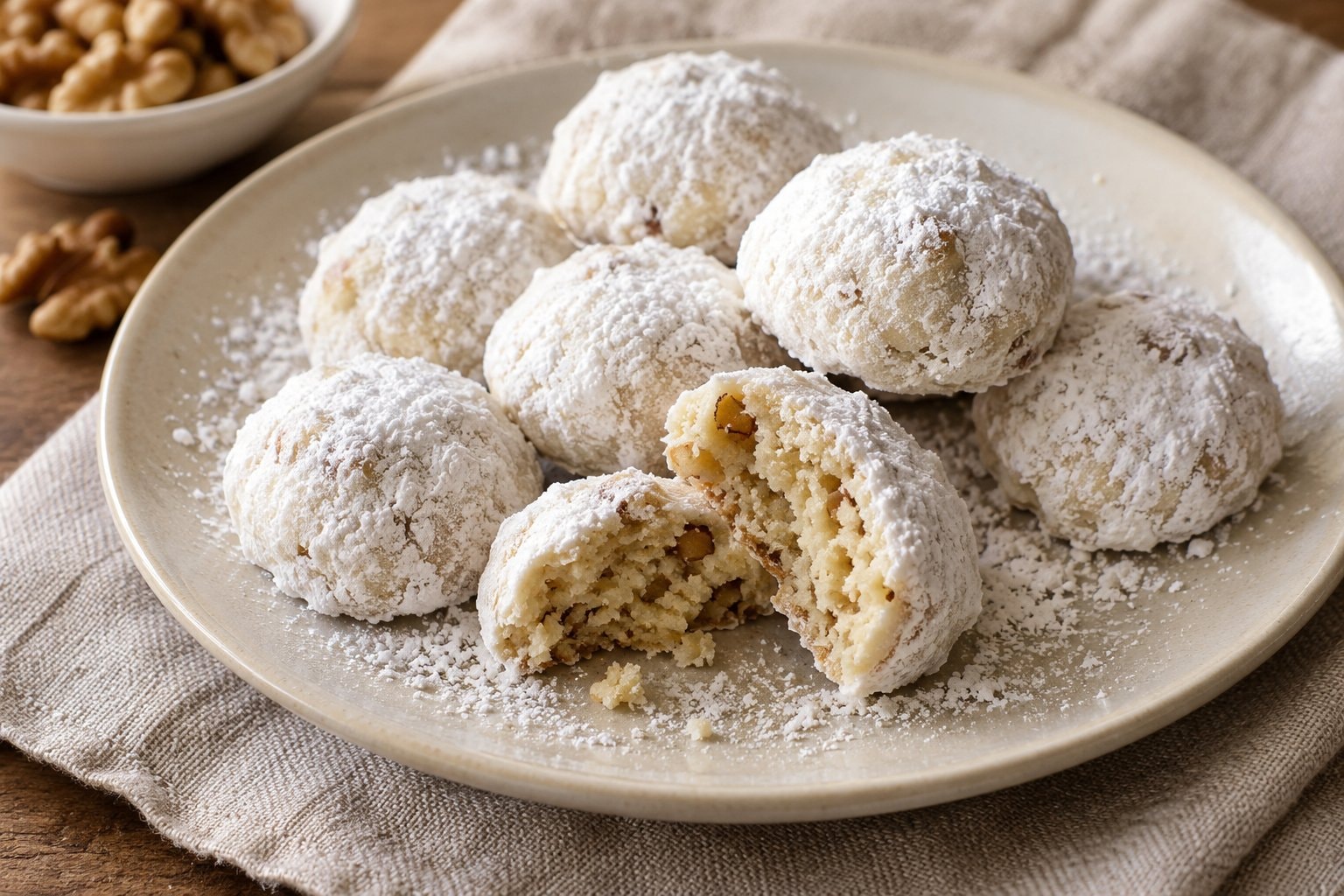
The snowballs below are small butter cookies shaped by hand and coated in powdered sugar. The name describes their round pale appearance. Walnuts supply the nut flavor; they are the edible seed of the walnut tree, separated from the shell before use. Chop them finely for this dough, so a large piece does not split a cookie as it is rolled.
A crumbly cookie asks for a gentle touch. Mix just until the flour disappears, then press a little dough together before deciding it is too dry. Portioning evenly matters more than making perfect spheres: similar-sized pieces bake together. The sugar coating is a finishing step rather than a decoration project. Let the cookies cool enough to handle, and use a light hand while turning them in the sugar.
Cinnamon walnut snowball cookies
These powder-coated cookies can be considered beside the nut biscuits of other places. Wikipedia's account of Andalusian desserts lists polvorones as almond cookies of Estepa. This walnut recipe has its own proportions and method, with cinnamon in the dough and powdered sugar on the outside.
Yield: 30 cookies. Active time: 30 minutes. Total time: 1 hour 30 minutes, including chilling and cooling.
Ingredients
- 120 g (1 cup) walnuts, finely chopped
- 170 g (¾ cup) unsalted butter, softened
- 70 g (½ cup plus 1 tablespoon) powdered sugar, for the dough
- 5 ml (1 teaspoon) vanilla extract
- 250 g (2 cups plus 1 tablespoon) all-purpose flour
- 3 g (1 teaspoon) ground cinnamon
- 2 g (⅓ teaspoon) fine salt
- 120 g (1 cup) powdered sugar, for coating
Method
- Heat the oven to 180°C (350°F). Spread the walnuts on a baking sheet and toast for 6–8 minutes, stirring once, until fragrant. Cool completely. Line 2 baking sheets with parchment.
- Beat the butter and dough sugar together until smooth and creamy. Mix in the vanilla. In another bowl, combine the flour, cinnamon and salt, then stir them into the butter mixture with the cooled nuts. Stop when the dough holds together.
- Cover and chill for 20 minutes. Scoop portions of about 20 g (a rounded tablespoon) and roll gently into balls. Arrange on the sheets with a little space between them.
- Bake for 16–20 minutes, until the bottoms are pale gold and the cookies are set. Turn the sheets partway through if the oven colors unevenly. Leave on the sheets for 5 minutes before moving carefully to a rack.
- Put the coating sugar in a shallow bowl. Roll the warm cookies gently in it, then return them to the rack. Once completely cool, coat them lightly again for an even white finish.
Kitchen notes
The nuts should be small pieces, not a paste. If using a food processor, pulse briefly and stop before they become oily. Soft butter mixes readily, but melted butter changes how the dough handles. Store the cooled cookies in an airtight container, separating layers with parchment so the sugar coating stays neat.