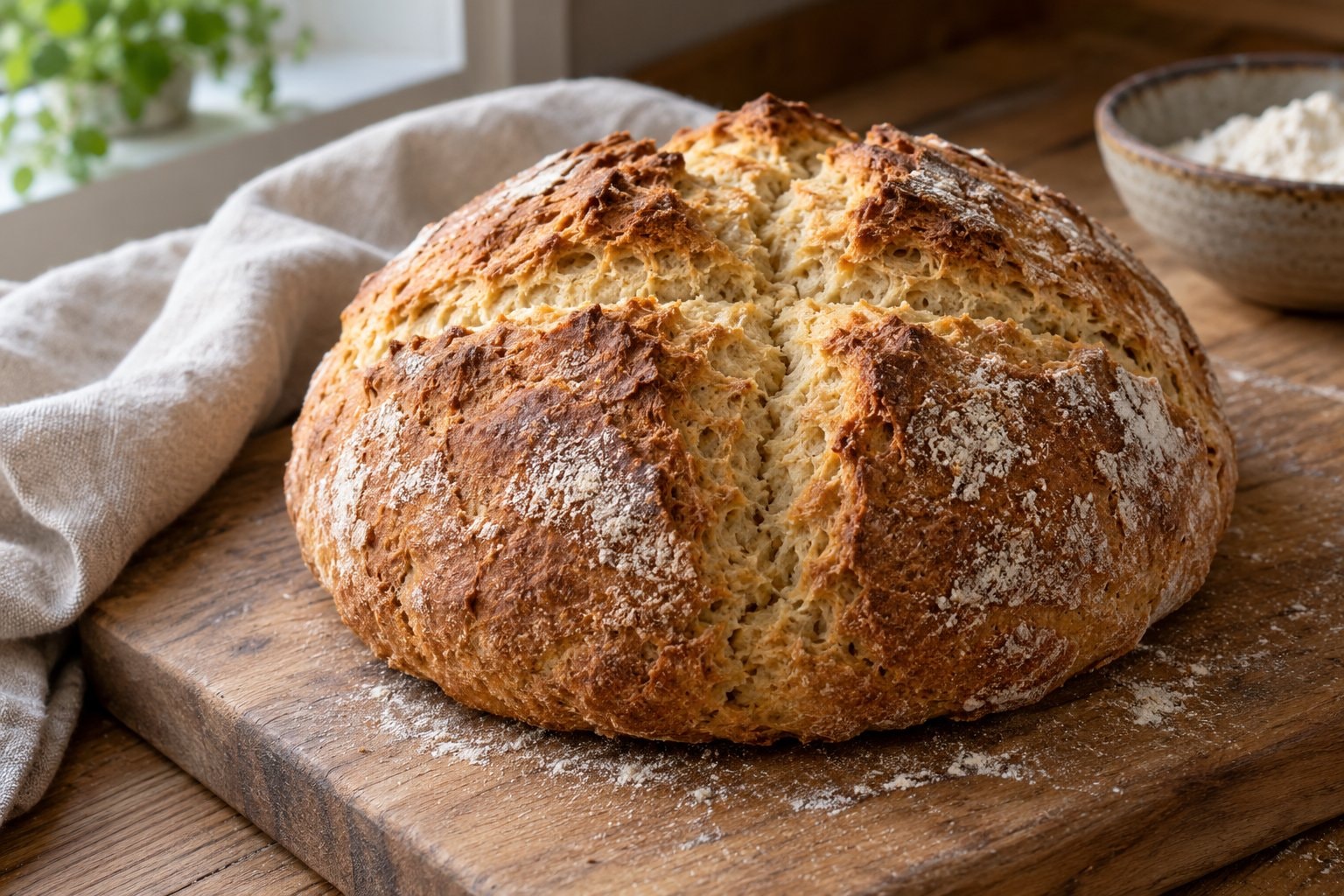
A loaf of soda bread offers a direct way into Irish cooking. The ingredients are modest and the handling is brief, but the bread still asks for attention: the dough needs enough liquid, the raising agent needs to be spread evenly and the center needs time to bake. A plain loaf also puts the rest of the table into view. Butter, a bowl of soup or a piece of cheese can sit beside it without asking the bread to become something else.
A table shaped by land and water
Wikipedia's account of Irish cuisine describes cooking grounded in the crops and animals of a temperate climate and in fish and seafood from the Atlantic waters around the island. Its discussion of older meals includes bread, fresh or fermented milk and cheese. Dairy belongs to that food history as well as to the soda-bread bowl, where buttermilk has a specific job to do.
The same account names dishes such as Irish stew, bacon and cabbage, boxty, coddle and colcannon. A bread loaf cannot stand in for all of them. It can, however, provide a useful starting point for reading a table built from grains, vegetables, meat and dairy. The cheese notebook follows the ways milk is changed into curds and different finished cheeses, adding another perspective on a familiar ingredient.
In home cooking, a simple bread is worth learning in its plain form before adding many extras. The recipe below has no raisins, sugar or elaborate topping. That keeps the flour, buttermilk and crust easy to judge. Once the dough's feel is familiar, small changes are easier to understand because there is less happening at once.
The Dingle Peninsula in view
Wikipedia's description of the Dingle Peninsula places it in County Kerry, ending beyond the town of Dingle at Dunmore Head, the westernmost point of mainland Ireland. Dingle Bay separates it from the Iveragh Peninsula to the south. Those details locate the peninsula without turning a food essay into a list of places to eat.
The coastal setting makes it possible to hold geography beside the wider account of Irish ingredients. The geography locates a coastline, while a dish calls for attention to particular ingredients and methods. A traveler can begin with smaller questions: what is the bread called, which ingredients are named and how is the dish cooked? The travel notebook takes that habit of close attention into other regional food cultures.
How a loaf rises without yeast
Soda bread uses baking soda rather than yeast. Buttermilk supplies lactic acid, which reacts with the soda and releases carbon dioxide. The bubbles expand the dough, so a long rise is not part of the method. Wikipedia's article on quick breads places soda bread among the breads lifted by chemical raising agents, alongside other familiar baking preparations.
The practical consequence is preparation before mixing. Heat the oven, ready the tray and measure everything while the ingredients are still separate. Combine the flour, soda and salt thoroughly so the raising agent is not concentrated in a small patch. Once the buttermilk is added, bring the dough together with a light hand and move it toward the oven. The task is forming a soft mass rather than developing the elastic dough of a kneaded yeast loaf.
Irish soda breads may use white flour, wholemeal flour or a mixture, with regional names that differ. Wheaten bread and brown bread are among those names. The recipe uses a mixture for a loaf with a clear wheat flavor and enough white flour to keep the dough easy to handle. The bread essay sets this method beside sourdough and other quick breads.
Buttermilk soda bread
Wikipedia's account of soda bread identifies flour, baking soda, salt and buttermilk as its basic ingredients. This loaf keeps to that plain foundation and combines whole-wheat and white flour. Mix gently and bake soon after the liquid reaches the flour.
Yield: 1 loaf, about 12 slices. Active time: 15 minutes. Total time: 1 hour 25 minutes, including cooling.
Ingredients
- 250 g (2 cups plus 1 tablespoon) whole-wheat flour
- 200 g (1⅔ cups) all-purpose flour, plus a little for dusting
- 6 g (1¼ teaspoons) baking soda
- 6 g (1 teaspoon) fine salt
- 375 ml (1½ cups plus 1 tablespoon) cultured buttermilk, with a little extra if needed
Method
- Heat the oven to 220°C (425°F). Line a baking sheet with parchment. Set out a large bowl, a sturdy spoon and a sharp knife before mixing.
- Mix the flours, baking soda and salt very thoroughly. Make a hollow in the center and pour in the buttermilk. Stir from the center outward until the flour is moistened. If dry flour remains that will not join the dough, add another 15 ml (1 tablespoon) buttermilk.
- Tip onto a lightly floured surface. Bring together with a few gentle folds, without extended kneading. Shape a round about 18 cm (7 inches) across and put it on the tray. The surface can look rough; it need not be polished smooth.
- Dust lightly with flour and cut a deep cross through the top, about halfway into the loaf. Bake for 15 minutes, then reduce the oven to 200°C (400°F). Bake for 25–30 minutes more, until deeply browned and firm underneath.
- Check the center with a skewer: it should not show sticky dough. If needed, return the loaf to the oven briefly. Transfer to a rack and cool for at least 30 minutes before slicing with a serrated knife.
Kitchen notes
Flours absorb liquid differently, so use the dough's feel as well as the measure: it should be soft and slightly tacky, never pourable. A tight, dry dough is difficult to bring together and can bake into a heavy center. Slice any remaining bread once cool and freeze it for toast, rather than leaving the loaf to become dry on the counter.