Scotland's food can be approached through an ingredient, a method or an occasion. Oats in a savory pudding and oats scattered into cream do different work. A carefully arranged supper and a piece of shortbread eaten without ceremony offer different settings. Looking at both food and occasion gives the regional table more depth than a familiar list of names.
Wikipedia's Scottish cuisine account describes a tradition with distinctive recipes as well as connections to British and wider European cooking. That is a useful way to keep regional identity open to detail. A dish can be strongly associated with a place without every ingredient or technique being exclusive to it.
A supper with an order of its own
The Wikipedia account of a Burns supper describes an occasion honoring the life and poetry of Robert Burns. Formal versions have a sequence, from gathering and welcome through the meal to speeches and songs. The food is part of the occasion rather than an interchangeable background to it.
The reference describes guests being greeted, a welcome and grace, soup, the entrance of haggis and an address to it, followed by the main course and later parts of the gathering. No poem needs to be quoted to see why this is interesting as food culture. A dish receives attention through how it is brought into the room, introduced and shared.
Haggis itself is described in the food reference as a savory pudding made with sheep's offal, onion, oatmeal, suet and seasoning, cooked in a casing. There is no haggis recipe here. The point is to identify the preparation accurately rather than use its name as a shorthand for all Scottish cooking. Rumbledethumps offers a different example: a dish from the Scottish Borders built around potato, cabbage and onion.
The travel notebook considers other regional foods through their ingredients and settings. The same patience is useful here. A named celebration can open a discussion, but quieter everyday dishes also deserve a place in it.
Oats and berries, butter and flour
Cranachan turns attention toward cream, raspberries and toasted oats, with whisky recorded as part of its traditional ingredients. The preparation offers a contrast of soft fruit and dairy with a little crisp grain. The short method below treats the whisky as optional, allowing the other components to remain clear.
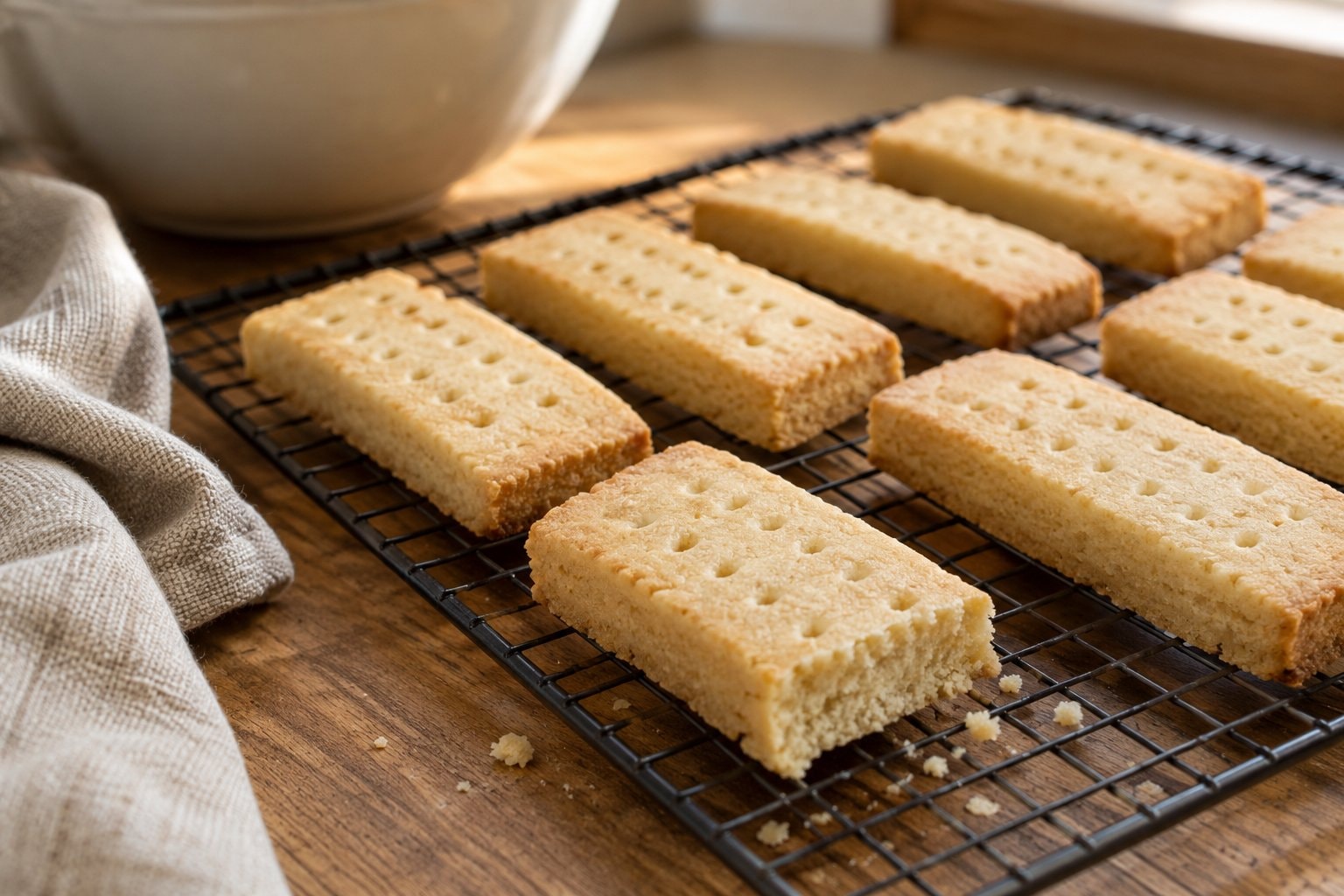
Shortbread asks a different question of the cook: how to make a rich dough that holds together yet breaks cleanly. The reference describes it as a Scottish biscuit without leavening. Its quiet appearance makes texture especially noticeable. A restrained method suits it better than an elaborate finish.
The holiday-cookie essay sets shortbread beside other small baked sweets. For a home cook, the comparison can begin with the dough: whether it is rolled, shaped, dropped or pressed into a pan. Naming the action before beginning makes it easier to notice when a mixture needs more attention.
Shortbread fingers
Wikipedia's shortbread article identifies a Scottish biscuit made without a raising agent. This recipe combines all-purpose and rice flour for a fine, crumbly result. It is pressed into a pan and cut into fingers, so there is little handling after the dough comes together.
Ingredients
- 150 g (10½ tablespoons) unsalted butter, softened
- 65 g (⅓ cup) superfine sugar, plus a little for finishing
- 190 g (1½ cups plus 1 tablespoon) all-purpose flour
- 40 g (¼ cup) rice flour
- 2 g (⅓ teaspoon) fine salt
Method
- Line a 20 cm (8-inch) square pan with parchment, leaving a flap for lifting. Set the oven to 160°C (325°F).
- Work the butter and sugar with a wooden spoon until smooth. Keep the mixture creamy rather than beating it until very airy. Blend the flours and salt separately, then work them into the butter.
- Press the dough into the pan in an even layer. Smooth the surface with the back of a spoon. Prick it lightly with a fork and score lines for 16 fingers.
- Bake for 35–40 minutes, until the edges are pale gold and the center looks dry. Sprinkle lightly with sugar. Follow the scored lines with a knife while the shortbread is warm.
- Let it rest in the pan for 20 minutes, then lift carefully to a rack. Separate the fingers once they are firm enough to handle.
A short cranachan method
Wikipedia's cranachan account describes a Scottish dessert of raspberries, cream and oats, traditionally also containing whisky. This small preparation leaves that ingredient optional. Fold it gently and serve while the toasted oats retain their contrast.
Ingredients
- 35 g (⅓ cup plus 1 tablespoon) rolled oats
- 250 g (2 cups) raspberries
- 250 ml (1 cup) heavy cream
- 30 ml (2 tablespoons) honey
- 10 ml (2 teaspoons) whisky, optional
Method
- Toast the oats in a dry skillet over medium heat, stirring until fragrant and lightly colored. Spread them on a plate to cool.
- Whip the cold cream to soft peaks. Fold in the honey and optional whisky, then ripple in roughly mashed raspberries.
- Divide the mixture among bowls and scatter on the cooled oats just before serving.