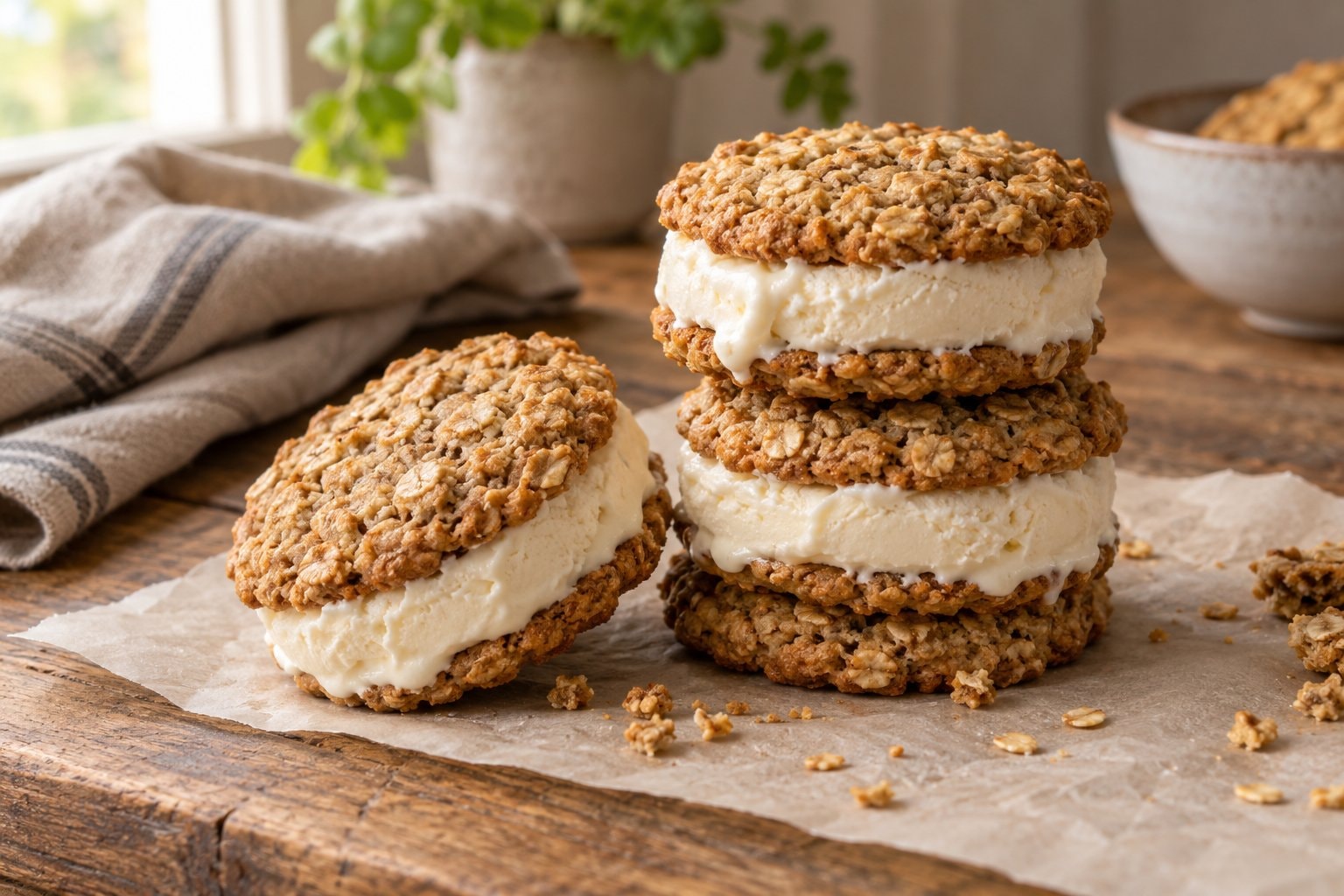
A city's food can be approached through both a remembered dish and the ingredients around it. In San Francisco, an ice-cream sandwich associated with a seaside amusement park offers a compact point of entry. Artichokes and stone fruit lead into a wider California conversation about produce and seasonality. The subjects need not belong to the same category to illuminate the same place: a food culture includes particular inventions as well as broad patterns of cooking.
A sandwich from Playland
Wikipedia's It's-It account records the invention of the ice-cream sandwich at San Francisco's Playland at the Beach in 1928. It describes ice cream between oatmeal cookies, covered in dark chocolate. That is a fact about a particular food and its setting. The dish can be discussed as part of the city's food story without turning the discussion into a recommendation or a claim about its quality.
The combination is also a useful kitchen subject. A sandwich depends on the relationship between a firm exterior and a softer filling. The cookie must hold when handled, yet yield when bitten with cold ice cream. Its diameter, thickness and degree of baking all become practical choices. A decorative cookie that is pleasant on its own may be awkward in a frozen sandwich if it is too thick or too brittle.
The home recipe below begins with those ordinary questions of structure. It uses oatmeal cookies and vanilla ice cream, keeping the assembly simple. The cookie is gently spiced and the sandwiches are frozen briefly to hold their shape. There is no coating step. The result is a home baking project with its own proportions and method, rather than an attempt to reproduce a commercial formula.
California cuisine and regional American cooking
Wikipedia's California-cuisine article describes a movement that arose in Northern California, emphasizing local ingredients and seasonality. It distinguishes that movement from the wider traditional foods of the state and notes influences from several other culinary cultures. That distinction leaves space for both a stated cooking philosophy and the many foods that people actually make and eat.
American cooking contains regional traditions shaped by local resources, demographics and invention. California belongs within that larger pattern. A single city dish cannot stand for the whole state, just as an emphasis on produce cannot explain every meal. The useful task is to identify the scale of the description. A particular sandwich has a specific history; a culinary movement describes an approach; a regional cuisine contains a much broader range.
This way of reading also keeps seasonality concrete. A cook can begin with what is available and decide whether it suits a raw preparation, roasting or a dessert. That choice is more informative than a general claim that a style is fresh. The food-markets essay follows similar exchanges between ingredients, questions and methods at a different kind of table.
Artichokes: a bud with several edible parts
Wikipedia's artichoke reference records that Spanish immigrants brought artichokes to California in the nineteenth century. The food is an unopened flower bud from a cultivated thistle. Its edible parts include the fleshy lower portions of the bracts and the base called the heart. That botanical structure explains why eating a whole artichoke involves more than cutting it into ordinary vegetable pieces.
The same source describes several preparations of hearts and leaves, including steaming and dishes filled or cooked with other ingredients. It also records fried hearts in coastal California. For a home cook, the whole bud and a prepared heart present different tasks. Both have a place in the kitchen, but the name alone does not tell how much trimming or cooking a particular form needs.
Looking at the vegetable before selecting the method is a useful habit. A bud's parts can be identified; a dish can then be planned around what will be eaten. The ingredient invites close attention to structure, in much the same way that a sandwich invites attention to its layers. The scale is different, but the practical question is similar: what form makes the food workable at the table?
Stone fruit and the home freezer
Wikipedia's peach account places peaches among stone fruits and explains that nectarines are glossy-skinned, non-fuzzy forms of the same species. When summer fruit is at hand, its texture can guide the dessert: slice it alongside the sandwich, cook it into a separate fruit dish or let it remain the focus of a simple plate. The cookie project does not need extra filling to become more complicated.
The ice-cream essay examines cooked custard bases and frozen variations. The breakfast essay follows oats into granola and other morning dishes. Here, oats enter a cookie that must be cooled completely before touching the frozen filling. That small sequence is the main practical point: warm cookies and ice cream are difficult partners.
Oatmeal-cookie ice-cream sandwiches
These gently spiced cookies are baked until their edges are set and their centers are fully cooked but still soft. Pair equal-size cookies before adding the ice cream. Work with a small part of the filling at a time so the rest stays frozen.
Ingredients
- 115 g (½ cup) unsalted butter, softened
- 100 g (½ cup, packed) light brown sugar
- 75 g (⅓ cup plus 1 tablespoon) granulated sugar
- 50 g (1 large) egg
- 15 ml (1 tablespoon) milk
- 150 g (1¼ cups) all-purpose flour
- 100 g (1 cup) rolled oats
- 3 g (½ teaspoon) baking powder
- 2 g (½ teaspoon) baking soda
- 2 g (1 teaspoon) ground cinnamon
- 2 g (¼ teaspoon) fine salt
- 750 ml (3 cups) prepared vanilla ice cream
Method
- Beat the butter and sugars until smoothly combined and slightly lighter. Beat in the egg and milk. In another bowl, combine the flour, oats, baking powder, baking soda, cinnamon and salt. Stir into the butter mixture. Chill for 20 minutes.
- Heat the oven to 180 °C (350 °F). Line 2 baking sheets with parchment. Divide the dough into 16 equal balls, space apart and flatten into broad rounds about 8 cm (3 inches) across.
- Bake for 11–14 minutes, until lightly browned at the edges and cooked in the center. Leave on the tray for 5 minutes, then move to a rack. Cool completely.
- Pair cookies of similar size. Let a small portion of the ice cream soften just enough to spread. Place a scoop on the flat side of a cookie, add its partner and press gently to an even thickness.
- Put each sandwich on a chilled tray as it is assembled. Freeze for at least 1 hour to firm the filling, then wrap individually and keep frozen. Serve straight from the freezer or let stand briefly for an easier bite.