A city can be read through the food sold in public and the food made quietly at home. London offers both routes. A market displays ingredients, while a pudding shows what a cook chooses to do with them. Neither needs to carry the whole story. Starting with a basket of fruit or a piece of pastry keeps the discussion close to something tangible.
Wikipedia's account of English cuisine describes a cooking tradition with its own features and a long history of taking in ingredients and ideas from elsewhere. Its account also addresses the reputation of English food. A reputation is a broad judgment; examining a dish asks for more precision. What is the pastry like? Which fruit is used? How is the cream handled?
A market as a place of attention
Wikipedia describes Borough Market as a wholesale and retail food market in Southwark, London, with a present emphasis on specialty foods. Naming it here locates a kind of urban food space, rather than recommending a business. The more useful question for a cook is what a market makes visible about an ingredient.
Look at the differences within a display. Fruit can vary in ripeness and shape; leafy produce can vary in how it needs to be handled. A useful market conversation might concern the intended preparation rather than a vague request for whatever is best. Fruit for a cooked filling and fruit to fold gently into cream need not be chosen for the same reason.
That way of looking connects the city with the land beyond it. The farming essay explains farmers' markets, city farms and the different questions covered by food policy. The food-market discussion compares forms of selling without assuming that every stall represents the same relationship with a grower.
Pastry, fruit and the meaning of pudding
Eccles cakes provide a compact example of baked fruit. The reference account describes a small round turnover filled with currants and made with buttery flaky pastry, originating in Eccles. The filling and the outside work together. For a cook reading about the dish, the important distinction is not the word cake but the construction: fruit enclosed in pastry.
A fruit fool offers a softer comparison. Wikipedia's fruit-fool account describes a traditional English dessert of puréed cooked fruit folded into sweet custard, with modern versions often using whipped cream. Here the fruit is dispersed through the dairy rather than enclosed. The preparation invites attention to how smoothly the fruit is combined and how much texture remains.
The comparison also helps explain why a recipe title cannot do all the work. Pudding can refer to a broad family of preparations in everyday discussion; the method clarifies what is meant on the page. Read the ingredients and the sequence before judging how elaborate a dish is likely to be. A simple mixture can still depend on careful timing.
Eton mess: separate textures, briefly together
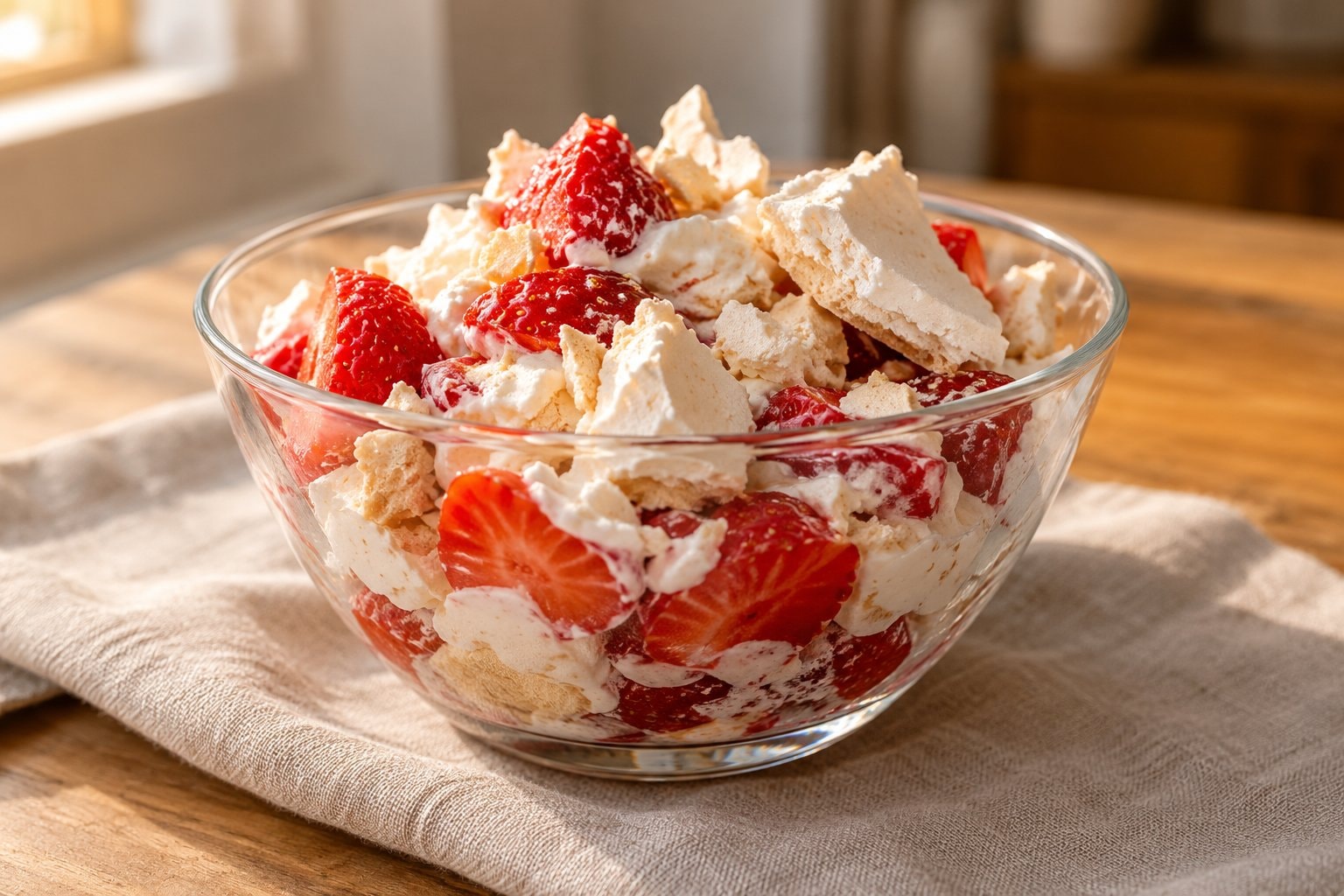
Strawberries, meringue and whipped cream are the components described in the Eton mess reference. The charm of the preparation can be approached as a contrast: fruit that releases juice, cream that carries it and a meringue that begins crisp. The recipe below uses fully baked plain meringues, allowing attention to stay on the assembly.
A cook can choose whether the fruit remains in pieces or becomes partly mashed. The method here combines both, so the cream takes on some strawberry flavor while recognizable fruit remains. The meringue is folded in near the end. That timing is a practical way to retain contrast, rather than a claim that Eton mess has a single prescribed texture.
The preserves essay follows fruit into jam and the question of a set. The same strawberry can suggest very different kitchen work. Keeping those methods separate makes each easier to understand: an assembled dessert is judged at the table, while a preserve asks for a different kind of attention to cooking and storage.
Strawberry Eton mess
Wikipedia's Eton mess article describes the mixture of berries, meringue and whipped cream. This version uses plain, fully baked meringues and a little lemon to sharpen the fruit. Assemble it near serving time, with enough gentle folding to bring the ingredients together without making a smooth purée.
Ingredients
- 400 g (about 3 cups) strawberries, hulled
- 20 g (1½ tablespoons) granulated sugar
- 10 ml (2 teaspoons) lemon juice
- 300 ml (1¼ cups) cold heavy cream
- 5 ml (1 teaspoon) vanilla extract
- 80 g (about 3 cups of broken pieces) plain fully baked meringues
Method
- Cut most of the berries into bite-size pieces. Mash a small handful with the sugar and lemon juice, then stir it through the cut fruit. Leave the bowl for 10 minutes while preparing the cream.
- Whisk the cold cream with the vanilla until soft ridges appear and the cream holds a relaxed peak. Stop before it becomes stiff or grainy.
- Break the meringues into uneven pieces. Keep some larger fragments so their texture is noticeable.
- Fold the berries and their juice through the cream with broad strokes. Add the meringue pieces last, divide among bowls and serve promptly.