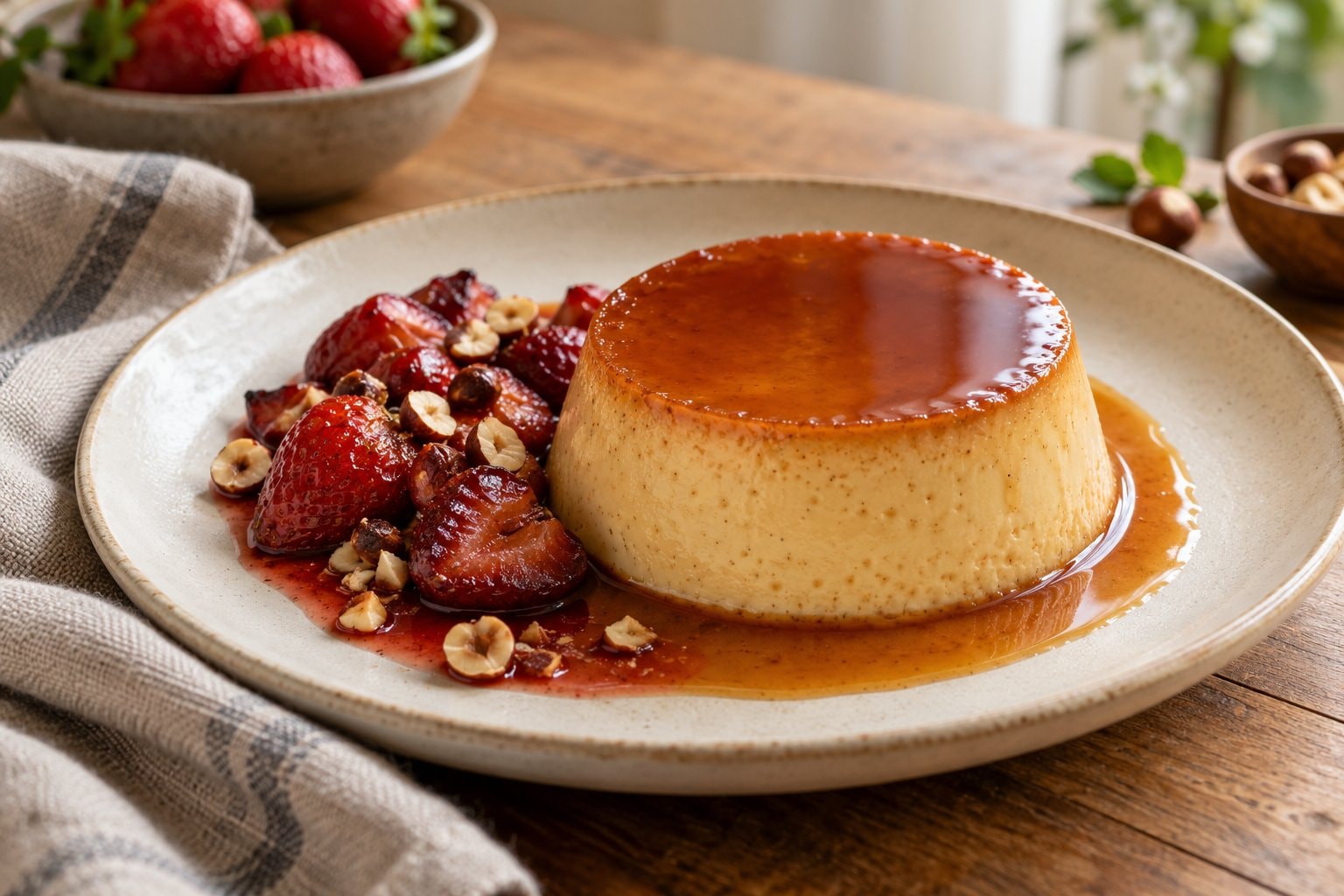
A spoon can describe a dessert almost as clearly as its name. A pouring custard runs back into the dish. A baked flan holds its shape, then yields at the edge of the spoon. A panna cotta wobbles, although its structure comes from a different ingredient. Understanding the set makes it easier to cook these dishes with intention: the question is how to produce the desired texture and stop at the right moment.
Flan, budino and the question of structure
Names such as flan and budino can begin the conversation, but the recipe's thickening ingredient tells a cook more than a label alone. The custard reference describes preparations made with milk or cream and eggs, sometimes with starch or gelatin as well. It ranges from thin sauces to dense pastry cream. Reading the ingredients before choosing a cooking method gives the name a practical meaning.
In an egg custard, heating changes the egg proteins and thickens the mixture. A stirred custard must stay mobile enough to pour; a baked custard is allowed to form a gel. Gentle, controlled heat matters because excessive cooking can make the texture curdled. A water bath helps moderate the transfer of heat in the oven. These details connect a dessert's structure to its method, rather than to a promise that an exact baking time works in every kitchen.
Pastry cream includes starch as well as eggs and dairy. It is designed for a different job from a pouring sauce: filling a pastry or supporting fruit. A flan meant to be turned out onto a plate also needs a firmer set than a custard served from a jug. The egg essay follows the same ingredient into foams and batters, where the desired structure changes again.
Fruit in batter, cream in a mold
Wikipedia describes clafoutis as a French dish associated with Limousin, in which sour cherries are covered with a thick, pourable batter and baked. It is a useful counterpoint to a smooth flan. The fruit remains visible inside a more substantial batter. The source records other fruit variations, but the traditional cherry form gives the dish its reference point.
Panna cotta is another counterpoint: sweetened cream is thickened with gelatin and chilled in molds. Its wobble therefore has a different explanation from an egg custard's set. The stock and gelatin essay follows that ingredient from a savory pot to a sweet cream dessert. Similar appearance does not require an identical method.
Hazelnuts belong to baking and confectionery, and their flavor makes a useful focus for a dairy infusion. Here, the nuts are chopped, warmed in milk and cream and strained out before the eggs are added. Strawberries supply the fruit alongside the flan. Their red color and juicy texture offer a visible contrast to the pale custard; roasting them is a choice made for this recipe, producing soft fruit and a spoonable juice.
Flavoring and the tonka question
Vanilla and a strip of citrus peel are straightforward flavoring directions for a custard. Warm dairy gives a cook time to infuse a flavor before committing eggs to the pan or mold. Remove a peel or pod before finishing the mixture, and keep the flavor gentle enough that the nuts or fruit still have a clear role.
Tonka beans are the seeds of Dipteryx odorata. The tonka reference attributes their strong fragrance to coumarin. The legal point for US food is specific: under eCFR's 21 CFR 189.130, food is considered adulterated if it contains added coumarin, whether added by itself or through tonka beans or tonka extract. This recipe uses vanilla. No tonka quantity or substitution is offered.
The distinction matters because a fragrant ingredient and a permitted food flavoring are different questions. An appealing description is not enough to settle the latter. The regulation addresses the added compound and the specified sources of it. A home recipe can keep the legal point clear and then return to the more ordinary decisions of dairy, eggs, heat and chilling.
Hazelnut flan with roasted strawberries
Wikipedia's custard account explains the egg thickening behind stirred and baked custards. This baked flan infuses the dairy with toasted hazelnuts, then strains them out for a smooth texture. A caramel-lined mold and roasted strawberries finish the dish.
Ingredients
- 80 g (½ cup) toasted, skinned hazelnuts, finely chopped
- 300 ml (1¼ cups) whole milk
- 300 ml (1¼ cups) heavy cream
- 1 vanilla bean, about 3 g (⅛ oz), split lengthwise
- 180 g (¾ cup plus 2 tablespoons) granulated sugar, divided
- 30 ml (2 tablespoons) water
- 200 g (4 large) eggs
- 36 g (2 large) egg yolks
- 1 g (a generous pinch) fine salt
- 400 g (14 oz) strawberries, hulled and halved
- 20 g (1½ tablespoons) extra granulated sugar, for the fruit
- 10 ml (2 teaspoons) lemon juice
Method
- Warm the milk, cream, hazelnuts and vanilla bean in a saucepan until steaming. Take off the heat, cover and infuse for 20 minutes. Strain through a fine sieve, pressing gently; remove the vanilla bean. Let the dairy cool until warm.
- Heat the oven to 160 °C (325 °F). Put 100 g (½ cup) of the sugar and the water in a small saucepan. Heat without stirring until amber. Carefully swirl to color evenly, then pour into a 20 cm (8-inch) round heatproof mold. Tilt to coat the base. The caramel is very hot.
- Whisk the eggs, yolks, remaining 80 g (⅓ cup plus 1 tablespoon) sugar and salt without making a foam. Gradually whisk in the warm strained dairy. Pour through a sieve into the mold.
- Set the mold in a deep roasting pan. Add hot water halfway up the mold. Bake for 50–65 minutes, until the custard has thickened and set with only a gentle tremble in the center; confirm at least 71 °C (160 °F) with a food thermometer. Remove carefully from the bath, cool briefly and refrigerate promptly.
- Raise the oven to 190 °C (375 °F). Toss the strawberries with their sugar and lemon juice in a shallow dish. Roast for 15–20 minutes, until soft with visible juices. Cool, then refrigerate.
- Chill the flan for at least 4 hours. Run a thin knife around the edge, place a rimmed serving plate over the mold and invert carefully. Spoon the strawberries and their juice alongside.