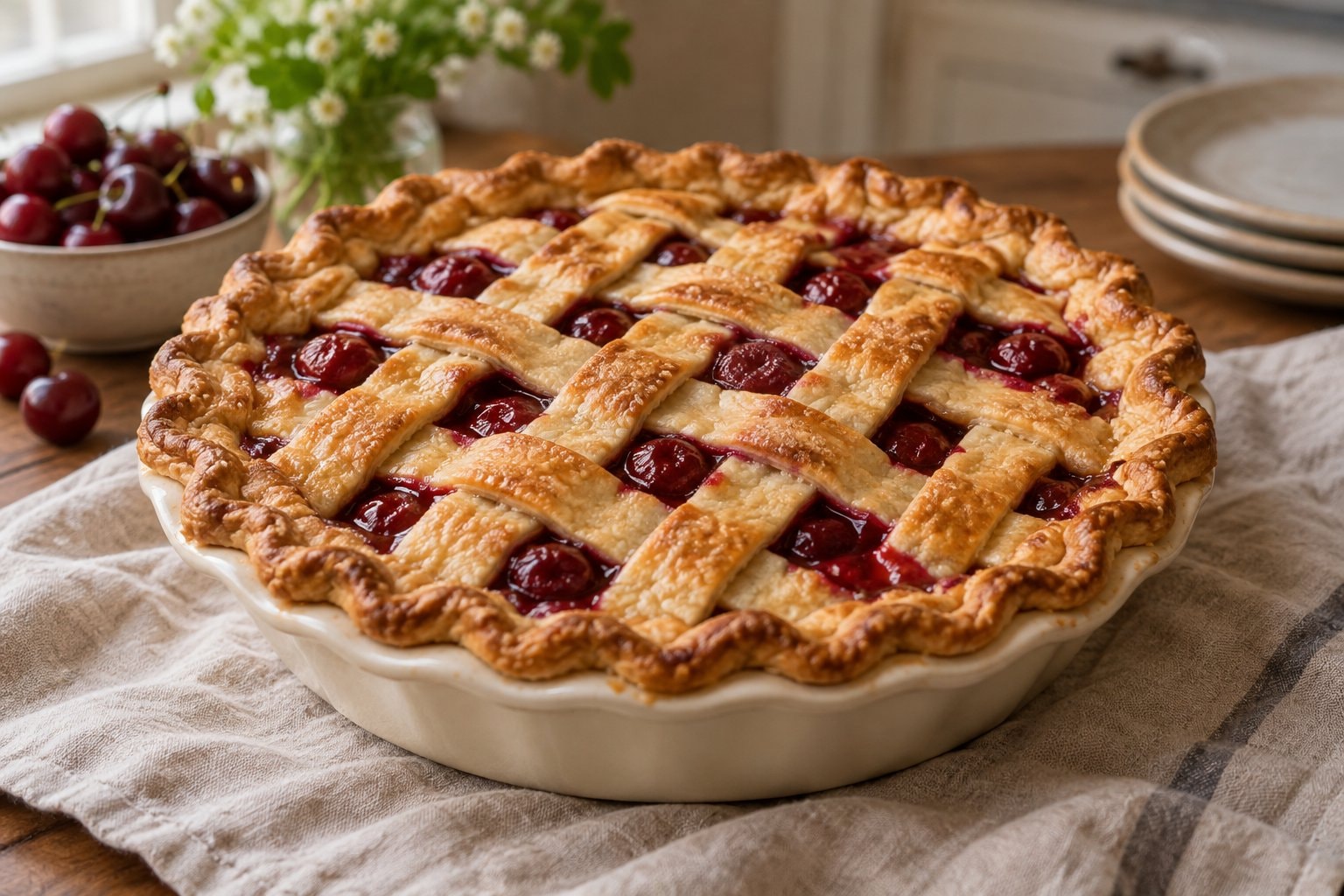
A fruit dessert begins with a practical question: what will hold the fruit? Pastry can make a sliceable case, a blanket of dough can soften over bubbling juice, and sweet crumbs can form layers around tender pieces. Wikipedia's history of pie describes Roman cooks enclosing meat and birds in a flour, oil and water covering to keep their juices inside. Pastry has a long story beyond dessert. For a home baker, that old relationship between a filling and its covering remains a useful place to start.
Pastry, crumbs and dumplings
A pie usually has a pastry casing around a sweet or savory filling. Fruit pies belong to that broad family, but they are far from the only way to bake fruit. A cobbler puts batter, biscuits or dumplings over the filling. Grunts and slumps belong to a related family in which dough sits on top of fruit and may cook on the stovetop. The lid changes the kitchen task: instead of rolling a crust, a cook drops a soft dough onto a simmering filling.
A brown Betty takes the crumb route, layering sweetened crumbs between fruit, often apples. For a crisp, a home cook can put a crumb-style topping over the fruit, leaving out the full pastry enclosure. At the table, the important contrast is between the tender filling and what surrounds it. Keep that contrast in mind when choosing a dish, rather than expecting every dessert with fruit and flour to behave like a pie.
The apple notebook includes a brown Betty, while the Vienna essay takes fruit into a stretched-dough strudel. Both invite attention to how a covering is made and handled. Here the focus is a sour cherry pie with an open lattice, followed by a much shorter stovetop peach dessert.
Let the filling lead
Sour cherries are closely related to sweet cherries but have more acidic fruit. That tartness gives a pie a clear identity even after sugar is added. Pit the cherries carefully, working over a bowl so the juices can stay with the fruit. Taste a piece before mixing the filling, and notice whether the fruit is sharply sour or softly tart. The recipe keeps a definite cherry flavor; it is not an attempt to turn sour cherries into sweet ones.
Peaches offer juicy flesh and a softer flavor. Rhubarb, by contrast, is the edible stalk of a plant, used in many of the same kitchen ways as fruit. Its tart stalks are commonly cooked with sugar in pies and crumbles. It is a useful reminder that the dessert drawer does not follow botanical categories. The preserves notebook follows another treatment of fruit: cooking it down into a spread rather than surrounding it with dough.
Wikipedia's article on key lime pie describes a Floridian pie made with lime juice, egg yolks and sweetened condensed milk, traditionally in a graham-cracker crust. Its smooth filling belongs to a different branch of the pie family from a heap of cherries. The name pie describes an arrangement, while the ingredients decide how the filling sets and how it must be cooked.
Sour cherry lattice pie
The fruit's tartness is the reason for choosing it. Wikipedia's description of sour cherries distinguishes them from the sweeter cherry by their more acidic fruit. A simple butter crust and an open lattice leave the filling at the center of this pie.
Yield: 1 pie, 23 cm (9 inches), serving 8. Active time: 45 minutes. Total time: about 5 hours, including chilling and cooling.
Ingredients
- 300 g (2½ cups) all-purpose flour
- 5 g (¾ teaspoon) fine salt
- 15 g (1 tablespoon) granulated sugar, for the pastry
- 225 g (1 cup) cold unsalted butter, cut into cubes
- 90–120 ml (6–8 tablespoons) ice water
- 900 g (6 cups) pitted sour cherries, fresh or thawed and drained
- 180 g (¾ cup plus 2 tablespoons) granulated sugar, for the filling
- 35 g (¼ cup plus 1 teaspoon) cornstarch
- 15 ml (1 tablespoon) lemon juice
- 5 ml (1 teaspoon) vanilla extract
- 15 g (1 tablespoon) unsalted butter, for the filling
- 15 ml (1 tablespoon) milk and 12 g (1 tablespoon) sugar, for the top
Method
- Mix the flour, salt and pastry sugar. Rub in the cold butter until the mixture has small flakes and pea-sized pieces. Add 90 ml (6 tablespoons) water, tossing with a fork. Add only enough extra water for the dough to hold together when pressed. Divide into 2 discs, wrap and chill for 1 hour.
- Roll a disc on a lightly floured board and line the pie dish, leaving an overhang. Roll the other disc and cut into 2 cm (¾ inch) strips. Chill both while preparing the fruit.
- Heat the oven to 220°C (425°F), with a heavy baking sheet inside. Mix the filling sugar with the cornstarch before folding in the cherries, lemon juice and vanilla. Spoon into the lined dish and dot with the filling butter.
- Arrange the strips in a lattice, trim the overhang and fold the edges together. Crimp, brush the pastry with milk and sprinkle with sugar. Set the dish on the hot sheet. Bake for 20 minutes, then reduce the oven to 180°C (350°F) and bake for 40–50 minutes more.
- Look for deeply golden pastry and thick bubbles in the center, not only at the edge. Shield the rim with foil if it colors too quickly. Cool on a rack for at least 3 hours before cutting, so the filling can settle.
Kitchen notes
Check every cherry for a remaining pit. Keep the pastry cold whenever it becomes soft or sticky. Frozen fruit varies in the liquid it releases; drain it well before weighing, and use the same quantity of fruit as listed. Cutting a warm pie gives a looser filling, so let patience do the final part of the work.
A short skillet peach grunt
This version keeps the fruit on the stovetop. Wikipedia's account of cobblers places grunts and slumps among the dumpling-topped variations. Use a skillet with a close-fitting lid, leaving it shut while the dough cooks.
Yield: 4 servings. Active time: 20 minutes. Total time: 35 minutes.
Ingredients
- 600 g (4 cups) sliced pitted peaches
- 60 g (¼ cup) sugar, plus 12 g (1 tablespoon) for the dough
- 60 ml (¼ cup) water and 15 ml (1 tablespoon) lemon juice
- 125 g (1 cup) all-purpose flour
- 5 g (1 teaspoon) baking powder and 1.5 g (¼ teaspoon) fine salt
- 30 g (2 tablespoons) cold unsalted butter
- 90 ml (6 tablespoons) milk
Method
- Simmer the peaches, filling sugar, water and lemon juice in a 25 cm (10 inch) skillet until the fruit releases juice.
- Mix the flour, remaining sugar, baking powder and salt. Rub in the butter and stir in the milk to make a soft dough. Drop 8 spoonfuls over the bubbling peaches.
- Cover, reduce the heat to a gentle simmer and cook for 15 minutes. Test a dumpling with a skewer; it should come out without wet dough. Serve warm, spooning the peach juice around the dumplings.
Kitchen note
Maintain a gentle bubble under the lid. Fierce heat can scorch the fruit before the dough cooks.