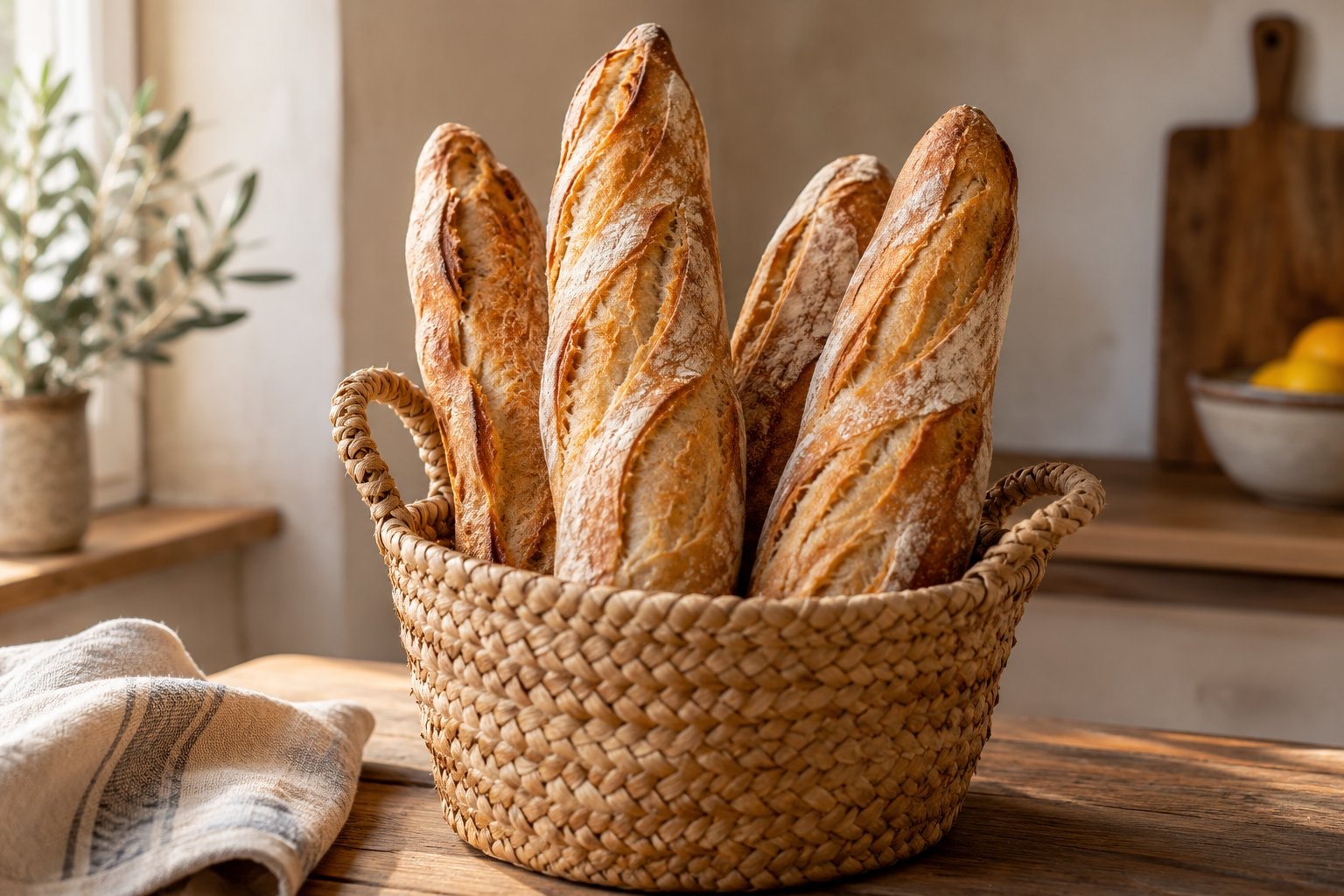
Bread can look simple on a table while containing many decisions. Flour and water become a dough or batter; a way of raising it changes its structure; shaping and baking give it a recognizable form. Comparing breads is therefore a useful way to connect food culture with kitchen technique. The name of a loaf matters, but the process explains what the name leaves out.
Wikipedia's bread account describes a food with a place in religious ritual and secular culture, reaching back to the beginning of agriculture. It also sets out different ways of leavening bread, including microbes and chemical raising agents. That range is a reason to avoid treating every loaf as the result of the same method.
The baguette is a craft as well as a shape
The baguette reference describes a long, slender loaf made from lean dough, with a crisp crust. Its familiar outline can make it seem defined by length alone. UNESCO's account turns attention toward the work that produces it, including mixing, fermentation, shaping, scoring and baking, along with the ways the bread is shared and obtained.
UNESCO listed the artisanal know-how and culture of baguette bread in 2022. Its account explains how knowledge passes through training and practical work. The listing concerns a living practice rather than a claim that an appealing shape is enough. For a reader, this makes the loaf a useful example of food understood through skill and social setting together.
The French pâtisserie is another kind of institution. The reference describes it as a bakery specializing in sweet baked goods and desserts; the word can also describe what is made there. A boulangerie and a pâtisserie can be discussed as food spaces without naming an individual business. The market essay takes a similarly close look at the relationship between a place of selling and the food passing through it.
Sourdough asks for fermentation
Wikipedia's sourdough account describes a leavening culture containing yeast and lactic-acid bacteria. Fermentation contributes the sour character associated with the bread. That explanation gives a cook something more precise than the idea that sourdough is simply a rustic-looking loaf.
A useful reading question is where waiting enters the method. Some bread relies on a culture being active before mixing; some asks for dough to rise after mixing and again after shaping. The visible signs matter as well as the clock. In contrast, the quick-bread recipe below organizes its work around combining a batter and getting it into the oven.
Pastry brings another distinction. The pastry reference describes doughs often enriched with fat or eggs, commonly without yeast. A flaky pastry and a bread dough can both begin with flour but pursue very different textures. Recognizing the intended structure before touching the mixture helps keep the method intelligible.
Quick breads make a different promise
A chemical raising agent distinguishes quick bread from a loaf raised by yeast or sourdough. The name concerns how the mixture is raised, not a guarantee that baking takes no time. Soda bread belongs in this discussion; the Ireland essay explains it through its own recipe and food setting.
Monkey bread offers a contrasting arrangement: soft pieces of baked dough intended to be pulled apart. Its reference describes sweet versions as well as the pull-apart form. Consider the shape as part of eating. A loaf cut into slices and a preparation broken into pieces organize a table differently, even when both are called bread.
The preserves discussion provides another route from a slice of bread into a kitchen process. To read widely while cooking carefully, keep each method distinct. A familiarity with kneaded dough is useful experience, but it does not mean a quick batter needs the same treatment.
Banana walnut quick bread
Wikipedia defines quick bread by chemical rather than biological leavening. This loaf uses baking powder and baking soda, with mashed banana providing a moist batter and walnuts adding texture. Mix it gently and give the center enough time to bake through.
Ingredients
- 250 g (2 cups) all-purpose flour
- 6 g (1½ teaspoons) baking powder
- 2 g (½ teaspoon) baking soda
- 3 g (½ teaspoon) fine salt
- 300 g (1¼ cups) mashed ripe banana
- 100 g (½ cup) light brown sugar
- 2 large eggs
- 80 ml (⅓ cup) neutral oil
- 60 ml (¼ cup) plain yogurt
- 5 ml (1 teaspoon) vanilla extract
- 75 g (⅔ cup) chopped walnuts
Method
- Line a 23 × 13 cm (9 × 5-inch) loaf pan with parchment. Warm the oven to 175°C (350°F). Mix the flour, raising agents and salt in a bowl.
- In a separate bowl, whisk the banana, sugar, eggs, oil, yogurt and vanilla until evenly combined. Tip the dry mixture into the wet mixture and fold only until no dry pockets remain. Fold in the walnuts.
- Scrape the batter into the prepared pan and smooth its top. Bake for 55–65 minutes. A skewer from the center should carry a few damp crumbs but no raw batter.
- Rest the loaf in its pan for 15 minutes. Lift it out with the parchment and cool further on a rack before slicing with a serrated knife.