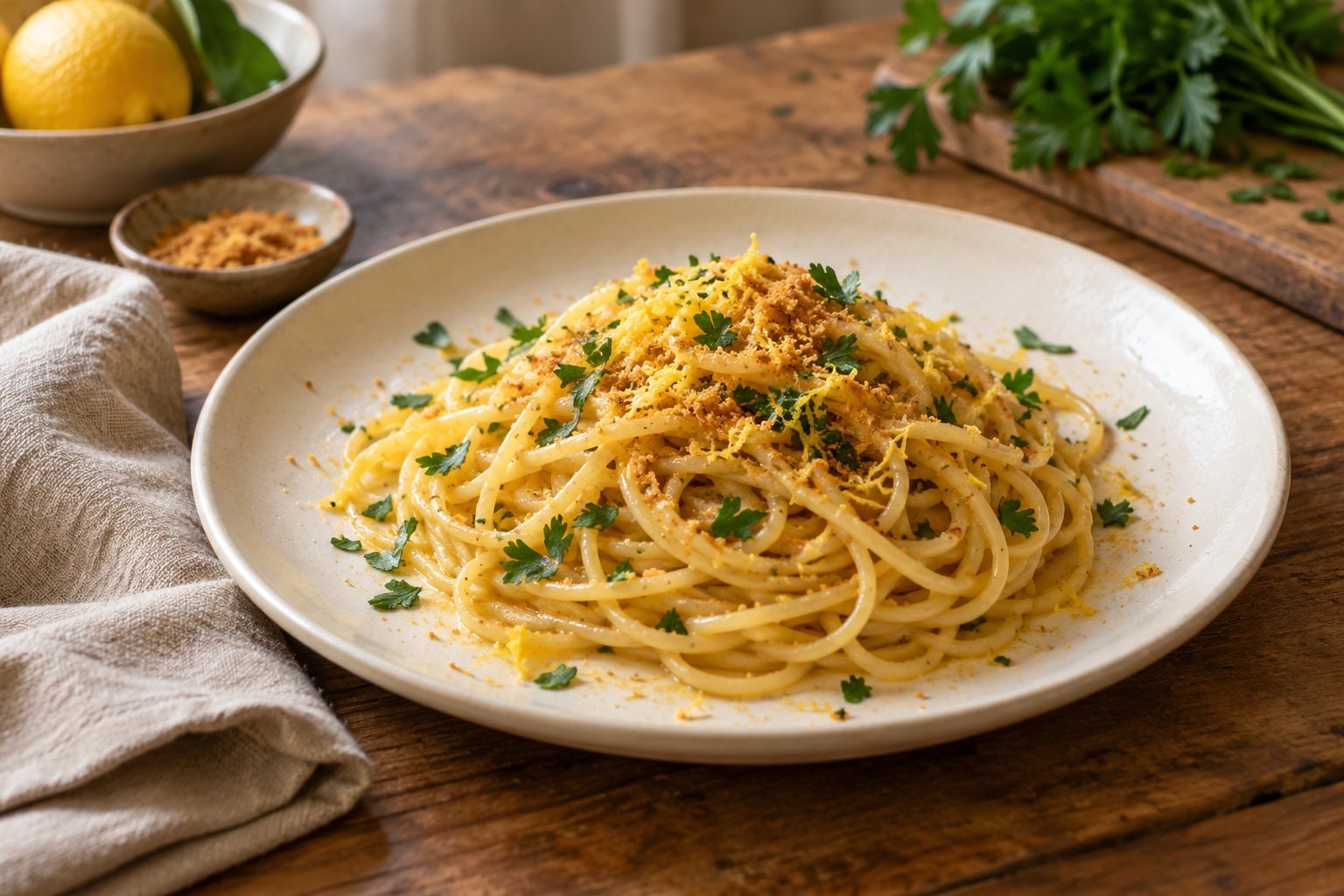
Bottarga is an ingredient to use with attention. Its compact, dry form belongs to the world of preservation, but it enters a dish in thin slices or fine shavings. A plate of pasta offers a clear example: olive oil, lemon and a little cooking water provide the setting, and the roe supplies its distinctive flavor. The pleasure is in allowing a concentrated ingredient to spread through a simple dish without making the other parts disappear.
Roe given a keeping form
Wikipedia's bottarga account defines it as salted, cured fish roe, commonly from grey mullet and sometimes tuna. The preparation described in the reference turns the roe pouch into a hard, dry slab by salting and drying. That is a description of a traditional food, not a method for curing fish at home. The recipe below begins with prepared bottarga and uses it as a finishing ingredient.
The pouch matters to the ingredient's identity. It keeps the roe together as a piece rather than a loose collection of eggs. That gives a cook the option of slicing the finished food thinly or grating it into a dish. The shape also helps explain why a little handling at the end of cooking can have such a visible effect. A pale tangle of spaghetti can be finished with an even scattering, while slices remain distinct beside bread.
Wikipedia's grey-mullet reference describes a coastal fish found in temperate, subtropical and tropical waters. It often enters estuaries and rivers and can adjust to different salinities. The same fish is known by several common names, including flathead grey mullet and striped mullet. Those names identify the animal behind a prepared ingredient; they do not imply that every bottarga has the same origin.
A Mediterranean ingredient with several homes
The bottarga reference describes mullet roe in Sardinia and tuna roe in Sicily, as well as related preparations in Greece, Egypt, Tunisia and Turkey. It records production farther afield too. This range makes it useful to think of bottarga as a family of preserved roe preparations rather than a single object with an identical method everywhere. Local names and practices belong beside the shared idea of salting and drying.
In the Italian uses described by the source, bottarga appears with olive oil or lemon alongside bread and also in pasta. These are direct settings for its flavor. A dish does not need an elaborate sauce to give the ingredient a place. The recipe here takes that simple direction, using lemon zest for aroma and a small amount of juice to sharpen the finish. Neither cream nor a long simmer is part of this particular version.
Italian cooking contains regional traditions as well as dishes that spread across the country with variations. An ingredient associated with a coast can take on a different role when it moves into another kitchen. The Siena and Tuscany essay examines fruit-and-nut cake and almond biscuits in a different regional setting. Reading the dishes side by side gives regional cooking more substance than a broad national label can supply.
Preservation, exchange and the shared table
UNESCO's Mediterranean heritage listing discusses skills involving farming, fishing, processing, cooking and sharing food. It gives markets a role in transmitting that knowledge and eating together a role in community identity. The subject is a set of practices as much as a set of ingredients. Bottarga fits a conversation about how food is kept, exchanged and then made part of a meal.
Preserved foods make an interesting meeting point between kitchen technique and place. A cook encounters the finished ingredient, but its form suggests earlier work. Asking what it is made from and where it was prepared can be useful without turning the answer into a claim about superior taste. The food-markets essay follows this kind of exchange; the seafood essay separates species and sourcing questions from cooking qualities.
Spaghetti with bottarga, lemon and olive oil
This is pasta finished with prepared cured roe, lemon and olive oil. Wikipedia records bottarga's use in Italian pasta dishes as well as with olive oil and lemon. The method keeps the final assembly quick, so the pasta reaches the table while warm and loose.
Ingredients
- 350 g (12 oz) dried spaghetti
- 50 g (1¾ oz) prepared mullet bottarga, finely grated
- 60 ml (¼ cup) olive oil
- 5 g (1 large clove) garlic, peeled and lightly crushed
- 2 g (1 teaspoon) finely grated lemon zest
- 15 ml (1 tablespoon) lemon juice, plus more to taste
- 10 g (¼ cup loosely packed) chopped flat-leaf parsley
- Salt, for the pasta water, and black pepper to taste
Method
- Bring a large pot of water to a boil and salt it lightly. Add the spaghetti and cook until just tender with a little resistance at the center. Reserve 250 ml (1 cup) of the cooking water before draining.
- Meanwhile, warm the olive oil and crushed garlic in a wide skillet over low heat for 3 minutes. Let the garlic soften and scent the oil without browning. Remove and discard it.
- Add the drained spaghetti to the warm oil with 90 ml (6 tablespoons) of the reserved water. Toss over low heat until the strands are coated and the liquid looks lightly creamy. Add more water a spoonful at a time if needed.
- Take the pan off the heat. Add the lemon zest, lemon juice, parsley and most of the bottarga. Toss well, taste and add black pepper. Add more lemon juice only if the dish needs it.
- Divide among warm plates and scatter the remaining bottarga over the top. Serve immediately, while the strands move freely when lifted with a fork.